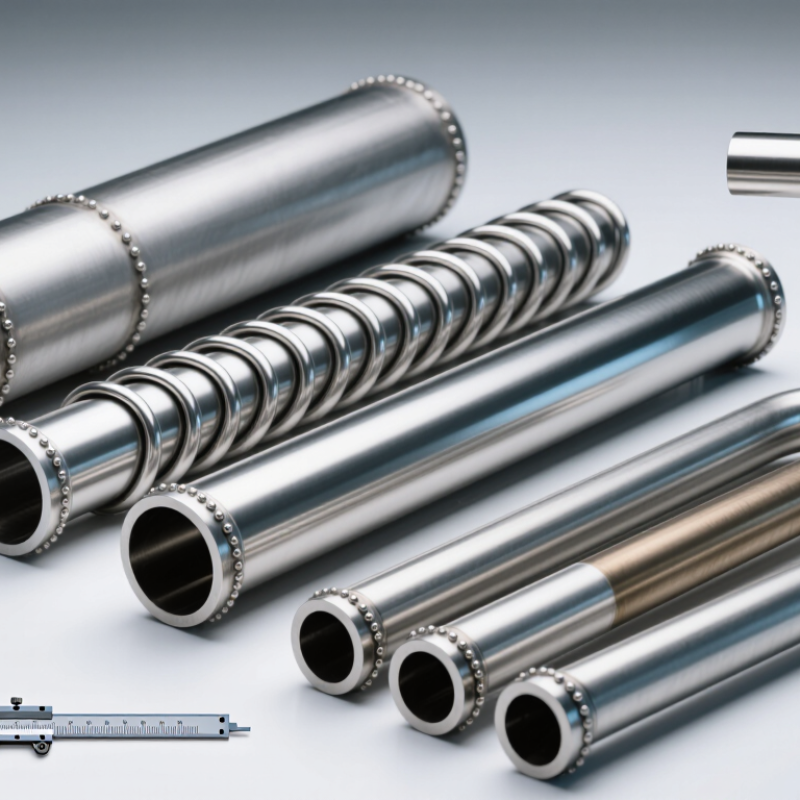
2026 Top Stainless Steel Welded Pipe Types?

Choosing the right Stainless Steel Welded Pipe in 2026 requires more than comparing prices and surface finishes. Buyers must match pipe construction, grade, weld method, and service conditions. A pipe carrying clean water needs different priorities than one exposed to chlorides, heat, or repeated pressure changes.

This guide examines leading welded pipe types, including longitudinally welded, spiral welded, sanitary, heat-exchanger, and large-diameter options. It also considers common grades such as 304, 316L, and duplex stainless steel. Each grade behaves differently during fabrication and operation. For example, 316L generally offers stronger resistance to chloride-related corrosion than 304. However, it may not be the most economical choice for every indoor application.

Details matter. In practical inspections, weld alignment, bead consistency, pickling, passivation, and dimensional tolerance often reveal more than a polished product photograph. Experienced engineers also review wall thickness, end preparation, non-destructive testing, and traceable mill certificates. Relevant ASTM, ASME, EN, and project specifications should guide final selection, rather than marketing language alone.

No single pipe type wins every project. That answer is incomplete. Installation access, fluid chemistry, temperature, welding quality, and maintenance plans can change the recommendation. Some comparisons also remain imperfect because manufacturers use different testing methods and finish descriptions. This overview aims to clarify those differences with practical, evidence-based guidance. It supports engineers, distributors, fabricators, and procurement teams seeking dependable pipe performance in 2026. Verify every critical detail before ordering, especially for pressure-bearing or hygienic systems.

2026 Top Stainless Steel Welded Pipe Types?

What Defines Stainless Steel Welded Pipes in 2026?

What Defines Stainless Steel Welded Pipes in 2026?

In 2026, stainless steel welded pipes are defined by verified performance, not appearance alone. Their identity begins with steel grade, outside diameter, wall thickness, and forming method. A clean weld matters. So does consistent geometry.

Modern production increasingly combines automated welding with controlled heat input. This helps reduce distortion and limits changes in the heat-affected zone.

Inspectors may examine weld profiles, surface defects, and dimensional tolerance. Non-destructive testing can reveal problems that polishing may hide. That detail is easy to overlook.

Traceability also carries greater weight. Reliable pipes should connect material certificates, batch records, welding parameters, and inspection results. For demanding service, buyers may request radiographic, ultrasonic, or hydrostatic testing. The suitable choice depends on pressure, temperature, fluid chemistry, and installation conditions. A pipe for a food-processing line may require different surface treatment than one used outdoors.

Corrosion resistance is not guaranteed by the word stainless. Grade selection must match chlorides, acids, moisture, and cleaning chemicals. Pickling and passivation can improve the surface, but poor handling may cause contamination later. I have seen bright pipes fail expectations because storage exposed them to carbon-steel dust.

Appearance misleads.

In 2026, responsible evaluation should also consider lifecycle efficiency. Accurate sizing can reduce waste and unnecessary weight. Recyclable material helps, but production data still needs verification. Some specifications look impressive yet lack clear testing evidence. That deserves scrutiny.

How Stainless Steel Welded Pipes Are Classified

2026 Top Stainless Steel Welded Pipe Types?

How Stainless Steel Welded Pipes Are Classified

Stainless steel welded pipes are classified by how they are formed, welded, finished, and used. Longitudinally welded pipes have a straight seam along the pipe length. They suit process lines, structural supports, and general fluid transport. Spiral welded pipes use a helical seam and often serve larger-diameter applications. The manufacturing route affects strength, surface quality, and inspection requirements.

Welding method creates another useful category. TIG-welded pipe usually offers a clean, controlled seam for sanitary or precision service. High-frequency welded pipe can support efficient production and consistent dimensions. Laser welding may provide narrow seams and limited heat distortion, but it requires careful process control. No method is perfect. Poor alignment can cause local weakness, even when the outer surface looks smooth.

Classification also considers stainless steel grade, wall thickness, outer diameter, surface finish, and pressure rating. Austenitic grades are common where corrosion resistance and forming ability matter. Duplex grades may be selected for higher strength and chloride exposure. ASTM or ASME requirements can define chemical composition, dimensions, tests, and acceptance limits. In practice, buyers should review weld inspection records, heat numbers, hydrostatic tests, and end preparation. A polished surface alone proves little. The correct pipe depends on temperature, media, pressure, joining method, and cleaning needs. Small specification gaps can create expensive field problems.

Leading Stainless Steel Welded Pipe Types and Their Uses

2026 Top Stainless Steel Welded Pipe Types: Leading Types and Their Uses

In 2026, leading stainless steel welded pipe types will be defined by service, not appearance. Longitudinal TIG-welded pipe suits clean, controlled lines. Its smooth bore supports food, pharmaceutical, and laboratory systems. High-frequency welded pipe offers faster production for structural frames, water networks, and general process lines. Large-diameter spiral-welded pipe carries lower-pressure water and drainage flows. It is practical, but not universal. World Stainless reported 58.4 million tonnes of crude stainless steel production in 2023. That volume signals strong material availability, although it does not measure welded pipe alone.

For corrosive media, 316L welded pipe is common around chlorides, coastal equipment, and chemical plants. 304L remains sensible for kitchens, indoor water service, and many architectural applications. Sanitary pipe often receives internal polishing and orbital welding. These details reduce crevices, residue, and cleaning difficulty. The WHO and UNICEF Joint Monitoring Programme reported that 2.2 billion people lacked safely managed drinking water in 2022. Water infrastructure remains a substantial use case. Yet alloy selection cannot follow demand headlines.

Engineers should verify chloride concentration, temperature, pressure, weld procedure, and inspection records. ASTM and ASME requirements help control dimensions, materials, and pressure service. One weakness deserves attention: market reports often combine welded and seamless products. Their forecasts can look more precise than they are. I would not specify 316L by habit. A cheaper 304L system may perform better under mild exposure, while polished welds may matter more than higher alloy content.

2026 Top Stainless Steel Welded Pipe Types? - Leading Stainless Steel Welded Pipe Types and Their Uses

Stainless Steel Welded Pipe Type Typical Grades Main Manufacturing Method Key Properties Common Standards Typical Uses Important Selection Considerations
Austenitic 304/304L Welded Pipe 304, 304L Cold-forming of strip or plate followed by longitudinal electric-resistance, high-frequency, or fusion welding. Good general corrosion resistance, excellent formability, and strong weldability. The low-carbon 304L grade reduces the risk of sensitization after welding. ASTM A312 ASTM A269 EN 10217-7 Food and beverage lines, architectural piping, water treatment, kitchen equipment, general chemical service, and sanitary installations. Not the preferred choice for high-chloride environments or warm seawater because chloride pitting and stress-corrosion cracking can occur.
Austenitic 316/316L Welded Pipe 316, 316L Longitudinal welded construction using formed strip or plate with controlled heat input and post-weld finishing where required. Improved resistance to pitting and crevice corrosion compared with 304 because of its molybdenum content. ASTM A312 ASTM A269 EN 10217-7 Marine atmospheres, pharmaceutical equipment, chemical processing, coastal infrastructure, pulp and paper plants, and high-purity water systems. More expensive than 304/304L. It is still not universally suitable for concentrated chlorides, hot seawater, or severe reducing acids.
Stabilized Austenitic Welded Pipe 321, 347 Longitudinal fusion-welded or electric-welded pipe produced from stabilized stainless strip or plate. Designed for better resistance to intergranular corrosion after exposure to elevated temperatures. Grade 321 is titanium-stabilized; 347 is niobium-stabilized. ASTM A312 ASTM A358 High-temperature process piping, furnace components, thermal oxidizers, exhaust systems, heat-treatment equipment, and aerospace-related piping. Use the grade and welding procedure specified for the actual service temperature, thermal cycling, and corrosion environment.
Large-Diameter Austenitic Welded Pipe 304L, 316L, 321, 347 Plate forming followed by longitudinal or circumferential fusion welding; submerged-arc welding may be used for heavy-wall or large-diameter products. Suitable for large diameters and heavy wall thicknesses that are less practical to produce from standard tubular strip-forming processes. ASTM A358 ASTM A312 Process pipelines, refinery and petrochemical facilities, water transmission, cryogenic service, tank connections, and large exhaust or ducting systems. Inspect weld quality, radiographic or ultrasonic examination requirements, dimensional tolerances, heat treatment, and surface condition.
Duplex 2205 Welded Pipe UNS S31803, S32205 Formed plate or strip welded with a procedure designed to preserve the required ferrite-austenite phase balance. Higher strength than common austenitic grades, strong resistance to chloride stress-corrosion cracking, and good resistance to pitting. ASTM A790 ASTM A928 EN 10217-5 Oil and gas gathering lines, offshore platforms, desalination plants, seawater systems, chemical processing, and pressure-containing equipment. Welding heat input, interpass temperature, shielding, and post-weld phase balance require strict control. It is not normally solution-annealed in the same way as austenitic grades.
Super Duplex Welded Pipe UNS S32750, S32760 Specialized fusion-welded construction with controlled filler metal, heat input, and corrosion-performance testing. Very high resistance to chloride pitting, crevice corrosion, and stress-corrosion cracking, combined with high mechanical strength. ASTM A790 ASTM A928 Offshore production, subsea piping, seawater injection, desalination, flue-gas scrubbers, and aggressive chemical services. Higher material and fabrication cost. Welding qualification, ferrite control, heat treatment, and corrosion testing are especially important.
Ferritic Stainless Welded Pipe 409, 430, 439 Strip-forming followed by resistance or fusion welding, commonly with controlled heat input to limit grain coarsening. Magnetic, generally lower in nickel cost, and resistant to oxidation. Corrosion resistance varies substantially by grade. ASTM A268 ASTM A554 Automotive exhaust systems, appliance components, decorative tubing, heat shields, and moderately corrosive industrial applications. Usually less ductile than austenitic grades. Welding procedure and stabilization are important because excessive heat can reduce toughness and corrosion resistance.
Sanitary Welded Pipe 304L, 316L Precision welded tube or pipe with internal bead control, grinding, polishing, and cleaning to achieve a hygienic surface. Low-carbon stainless construction with smooth internal surfaces that reduce product retention and support clean-in-place operations. ASTM A270 3-A Sanitary Standards ASME BPE Dairy processing, breweries, food production, pharmaceutical manufacturing, biotechnology, and high-purity water distribution. Specify surface roughness, orbital-welding requirements, passivation, electropolishing, cleanliness, drainability, and hygienic fitting compatibility.
Heat-Exchanger and Boiler Welded Tube 304L, 316L, 321, 347 Precision longitudinal welding followed by sizing, testing, and finishing appropriate for heat-transfer service. Good dimensional consistency and corrosion resistance with thin-wall options for efficient heat transfer. ASTM A249 ASTM A269 EN 10312 Shell-and-tube heat exchangers, condensers, boilers, evaporators, superheaters, and process heating equipment. Review pressure, temperature, vibration, thermal cycling, tube-to-tubesheet joining, eddy-current testing, and resistance to the process fluid.
Decorative and Structural Welded Tube 304, 304L, 316, 316L, 430 Cold-formed strip welded longitudinally, then mechanically polished, brushed, or supplied with a mill finish. Good appearance, cleanability, and moderate structural performance; surface finish is often a primary specification. ASTM A554 EN 10219 Railings, handrails, furniture, architectural structures, display equipment, vehicle components, and public-space installations. Confirm whether the product is intended for pressure service or only mechanical and decorative use. ASTM A554 products are generally not pressure-rated pipe.

How Grades, Sizes, and Weld Finishes Affect Performance

In 2026, stainless steel welded pipe selection depends on more than corrosion resistance. Grade, dimensions, and weld finish must match the service environment. Austenitic grades such as 304 suit many water, food, and general industrial systems. Grade 316 offers stronger resistance to chlorides because of its molybdenum content. Duplex grades provide higher strength, but welding requires tighter control of heat input and phase balance. Ferritic grades can reduce cost, yet they may need careful consideration in low-temperature applications.

Size affects both flow and structural performance. A larger outside diameter can lower pressure loss, while wall thickness controls strength, weight, and welding distortion. Thin-wall pipe may look efficient on a drawing. It can become difficult to align during installation. Engineers should verify pressure ratings, temperature, corrosion allowance, and dimensional tolerances against applicable standards. Field measurements still matter. Drawings are not always perfect.

Weld finish also influences service life. A smooth, pickled, and passivated seam helps remove heat tint and surface contamination. Ground welds may suit hygienic systems, but excessive grinding can thin the wall. Orbital welding often produces consistent internal profiles, although poor fit-up can leave crevices. Visual inspection should be supported by dye penetrant, radiography, or other suitable testing when risk justifies it. A bright surface is not proof of a sound weld. That assumption deserves more scrutiny.

How to Choose the Right Stainless Steel Welded Pipe

How to Choose the Right Stainless Steel Welded Pipe

Choosing stainless steel welded pipe starts with the service environment, not the lowest quotation. World Stainless reported 58.4 million tonnes of crude stainless steel production in 2023. This scale reflects broad demand, but it does not make every grade suitable for every line.

For clean water, food processing, and moderate temperatures, 304 or 304L is often practical. Chloride exposure may require 316L, although it is not immune to pitting. Repeated heating can favor 321, while duplex grades may suit higher strength requirements. Review the fluid temperature, chloride level, pressure, and corrosion risk together. ASTM A312 covers many austenitic stainless welded pipes for pressure service. ASTM A358 addresses larger electric-fusion-welded pipe. ASME B36.19M helps verify stainless steel dimensions and wall thickness. Standards guide selection, but they cannot replace site testing.

Tips: Confirm the weld method and heat treatment. Inspect the longitudinal seam, especially near bends. Check mill certificates against the purchase specification. Never select by nominal diameter alone. A thicker wall may improve durability, yet it can complicate welding and increase cost. One detail is easy to miss: surface finish can affect cleaning and corrosion performance. In practice, the “best” pipe may be the wrong choice if fittings, expansion, or installation tolerances were ignored. Recheck the design with a qualified engineer before ordering.

Enquire Today

"*" indicates required fields