
A good Hand Crank Coffee Grinder For Camping should make fresh coffee without relying on batteries or a power outlet. On a quiet morning, that may mean turning a steel handle beside a tent while water heats nearby. But portability is only part of the story. Burr material, grind adjustment, capacity, and ease of cleaning all affect daily use. Small details matter. A loose handle or awkward adjustment can become frustrating when space is limited.
This guide introduces ten China-based suppliers of hand crank coffee grinders and highlights features buyers may want to compare. Supplier capabilities vary, so product descriptions should be treated as a starting point, not proof of performance. Check grinder dimensions, burr specifications, available customization, sample policies, and quality-control information directly with each company. If possible, test a sample with the beans and brewing method you expect to use outdoors. A compact grinder can still feel awkward after several mornings of hand grinding; that detail is easy to overlook in a product photo. The right choice depends on your routine, budget, and tolerance for a little extra effort. Verify the details before making a decision.
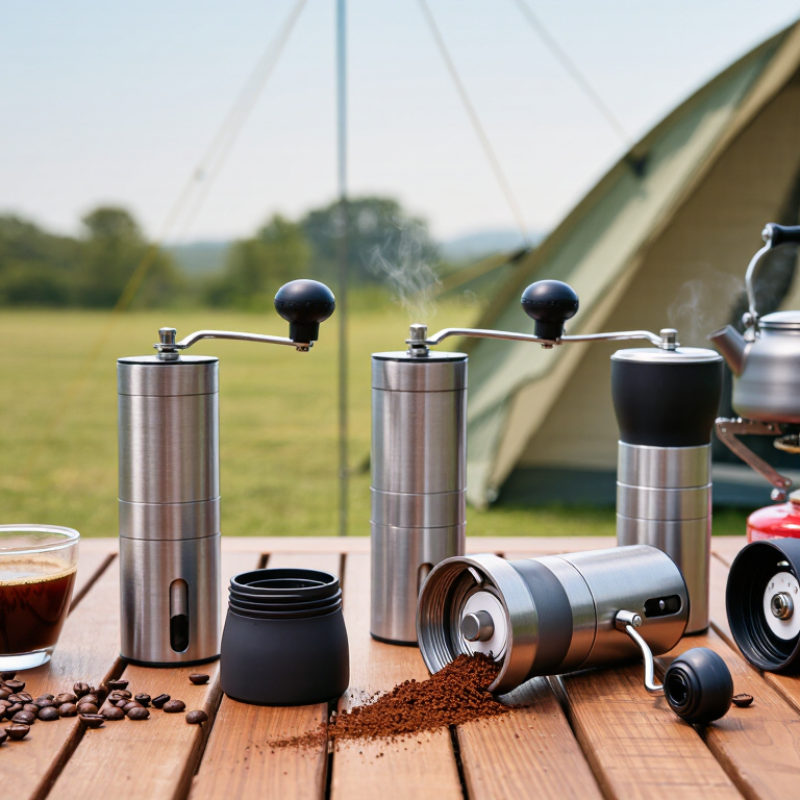
A hand crank grinder suits camping because it needs no battery, outlet, or bulky motor. It fits beside a small brewer, and its handle lets campers grind beans at a quiet campsite without adding much gear. Ground coffee can lose aroma after exposure to air, so grinding just before brewing helps preserve its fragrance. Keep the grinder dry and brush out the burrs after use.
Consistency still matters outdoors. The Specialty Coffee Association’s brewing guidance places ideal water temperature around 92–96°C and brewed-coffee strength at 1.15–1.35% total dissolved solids. A steady grind helps campers adjust extraction toward these professional reference points, even with a simple pour-over setup. Use a small scale if practical; otherwise, repeat the same scoop and grind setting each morning. Small changes count.
There is a trade-off. Grinding enough for several cups takes time, and cold fingers can make a compact handle awkward. A stable surface helps: set the grinder on a flat rock or firm table, then turn the crank slowly. Check whether the catch cup locks securely before packing it. A little coffee dust may escape. That is worth planning for. Sources: Specialty Coffee Association brewing standards and its Coffee Brewing Control Chart.
A practical, non-ranked checklist for comparing camping-focused hand grinder suppliers. The benchmarks below are buyer evaluation targets, not verified specifications for any particular supplier or product.
| No. | Supplier / Product Evaluation Dimension | Camping-Relevant Benchmark | Why It Matters Outdoors | What to Verify with the Supplier |
|---|---|---|---|---|
| 1 | Manual operation | Grinding should work entirely by hand, without batteries or mains power. | Useful at campsites where electrical power may be unavailable. | Request a working sample and confirm that the crank can be operated without external power. |
| 2 | Grind adjustment | Look for repeatable adjustment from relatively fine to coarse settings. | Different grind sizes suit different brew methods; coarse grounds are commonly used for French press, while espresso generally requires a finer, more controlled grind. | Ask for a grind-setting guide and test whether settings can be returned to consistently. |
| 3 | Burr construction | Compare burr material, alignment, and replacement availability; ceramic and stainless-steel burrs are both used in manual grinders. | Burr design affects grinding performance, while spare parts can extend product service life. | Confirm material specifications, burr dimensions, alignment tolerances, and availability of replacement burrs. |
| 4 | Bean capacity | A capacity around 20–30 g can suit many single-serve brewing routines; larger batches may need multiple fills. | Capacity affects how much coffee can be prepared before the next refill. | Ask for the usable bean capacity in grams and verify it with a sample; do not rely on hopper volume alone. |
| 5 | Weight and packed size | Compare measured product weight and packed dimensions against the intended backpack or kit. | Lower weight and compact packing can be advantageous for hiking and limited storage space. | Request net weight, packed dimensions, and measurements that include the handle and any case. |
| 6 | Crank and grip ergonomics | Check that the handle turns smoothly and offers a secure grip during repeated use. | A comfortable crank can make manual grinding easier, particularly when preparing several servings. | Test the crank with a typical dose of beans and inspect the handle attachment for looseness. |
| 7 | Travel retention and storage | Look for a handle that can be detached, folded, or securely stored, plus a lid or case where appropriate. | Keeping loose parts and grounds contained helps reduce mess in a backpack. | Check how the handle is secured for transport and whether the container closes securely when filled. |
| 8 | Cleaning and maintenance | Prefer a design that can be opened for dry cleaning without requiring complicated tools. | Removing retained grounds helps maintain the grinder between trips and brew types. | Request the cleaning instructions and confirm which components are removable; check whether water exposure is permitted. |
| 9 | Durability for transport | Assess the body, axle, adjustment mechanism, and handle for secure assembly and resistance to ordinary travel knocks. | Camping equipment is packed and carried, so loose or fragile components can be inconvenient. | Ask for material details and sample inspection; define any drop or cycle tests before placing an order. |
| 10 | Quality control and order readiness | Agree on a written specification, inspection plan, packaging details, and any required export documents before production. | Clear requirements help buyers compare samples with bulk orders and plan shipment preparation. | Request the supplier’s applicable inspection records and confirm documentation requirements for the destination market. |
Note: This table provides general product-selection guidance and does not identify, rank, or make performance claims about specific Chinese suppliers. Confirm all specifications with samples and written supplier documentation.