
Choosing Logistics Trolleys in 2026 is less about buying the strongest frame. It is about matching daily movement, floor conditions, and worker needs. A trolley crossing polished concrete behaves differently on ramps, loading docks, or uneven warehouse tiles. Start with the real load, not the advertised maximum. Record typical weight, peak weight, package dimensions, and travel distance. Then inspect how often operators turn, stop, and lift. Small details matter. A noisy wheel can reveal poor bearings or an unsuitable surface. A handle that sits too low can create repeated wrist strain. These observations give the selection process practical credibility. They also prevent attractive specifications from replacing evidence.
Reliable guidance should combine operator feedback, manufacturer documentation, and controlled trials. Check frame materials, wheel diameter, braking performance, platform height, corrosion resistance, and spare-part availability. Confirm that rated capacity reflects actual use, including uneven loads and frequent starts. Ask suppliers for test methods, warranty terms, and maintenance instructions. Applicable workplace safety requirements should guide the final decision. Smart features may help, but sensors do not compensate for unstable stacking or poor training. Do not overbuy. It wastes space and budget. Do not underbuy either. A cheaper trolley can cost more through damage, downtime, or fatigue. The choice I prefer is not always the best after a week on the floor. That is worth remembering. In 2026, the strongest decision will be measurable, worker-informed, and flexible enough for changing workflows. No trolley is perfect. The goal is dependable movement, safer handling, and lasting value.
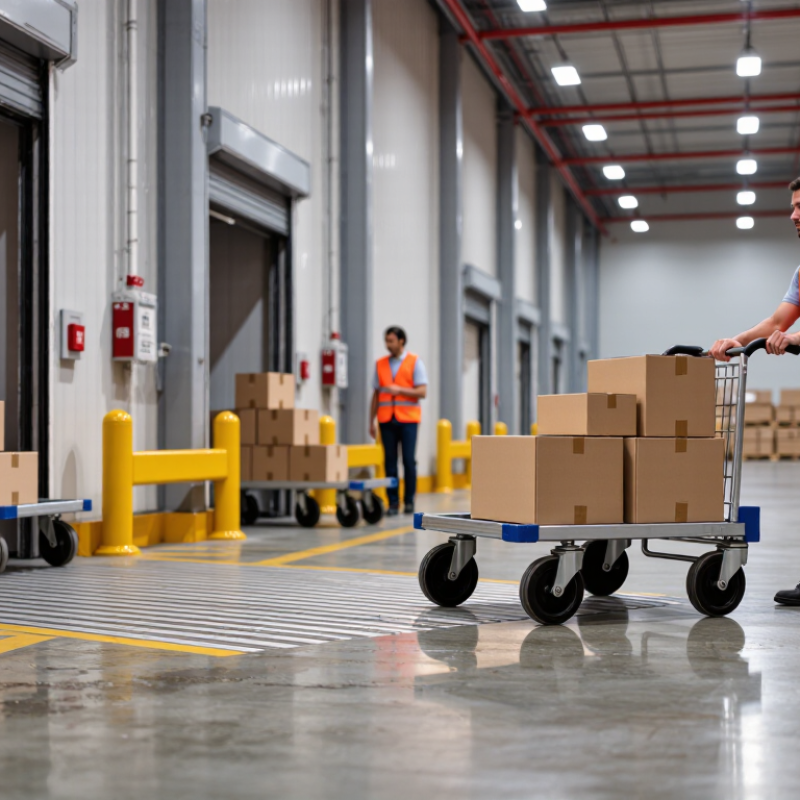
How to Choose Logistics Trolleys in 2026?
Choose the trolley by task, not by appearance. EN 1757-1 helps assess platform trucks used for manually moving boxes, tools, or mixed loads. These trolleys suit short warehouse routes, especially where workers need clear access from several sides. Check deck size, handle height, wheel diameter, and rated capacity together. A large platform can tempt users to overload it.
For enclosed, stacked, or unitized goods, EN 1757-3 is more relevant to roll containers. Its design focus includes container stability, access control, castors, and movement safety. Use roll containers when goods need vertical separation or direct transfer between storage and delivery areas. Measure doorways and lift entrances first. A container that fits the aisle may still jam at the fire door.
In practice, observe the route with a loaded trial trolley. Watch turning effort, ramp behavior, noise, and wheel tracking. Small details matter. A smooth floor can hide problems. One selection mistake is judging capacity only by kilograms, while ignoring load height and center of gravity. I would also record brake performance after repeated use, not after one clean test. Verify the applicable standard edition, workplace risks, and user instructions before purchase. EN 1757-1 or EN 1757-3 supports the decision, but neither replaces a site-specific assessment.
A trolley’s rated load is not enough. ISO 11228-2:2007 evaluates pushing and pulling through initial force, sustained force, travel distance, frequency, and direction changes. Measure the force with a calibrated dynamometer. Record the first movement and the force needed after ten metres. A 500 kg trolley may move easily on smooth concrete, yet struggle across a damaged threshold. Wheel diameter, bearing condition, floor slope, and load distribution all change the result.
Use the measured peak force, not an optimistic average. Compare it with the operator capability required by ISO 11228-2. Consider a safety margin for cold rooms, ramps, congestion, and worn wheels. The UK Health and Safety Executive reported 543,000 workers with work-related musculoskeletal disorders in 2023/24, causing 7.8 million lost working days. That figure shows why trolley selection should involve ergonomics, not only capacity. A spreadsheet can look precise. Real floors are less cooperative.
Tips: Load the trolley as it will operate. Keep heavy cartons low and centred. Test both empty and full conditions. Check initial force at the worst floor joint. If several operators show discomfort, reassess the design. ISO guidance supports evaluation, but it does not replace workplace trials or trained ergonomic judgment.
How to Choose Logistics Trolleys in 2026?
Wheel diameter directly affects effort on warehouse floors. Small 75 mm wheels suit smooth aisles and light loads. Larger 125–200 mm wheels cross door thresholds more easily. They also reduce vibration on cracked concrete. However, oversized wheels can increase turning resistance in narrow pick areas. A useful rule, but not a perfect one. Measure the floor.
Material choices change grip, durability, and noise. Polyurethane wheels usually run quietly on sealed concrete and resist many common oils. Rubber wheels provide stronger traction but may leave marks under heavy loads. Nylon wheels handle high loads well, yet they can sound harsh on hard floors. The Industrial Truck Association recommends matching wheel construction to load, floor condition, and operating temperature. That advice is practical, though it does not replace a loaded floor trial.
Noise ratings need careful interpretation. NIOSH’s Criteria for a Recommended Standard: Occupational Noise Exposure identifies 85 dBA over eight hours as a recommended exposure limit. HSE’s Noise at Work guidance uses the same 85 dB(A) upper action value. A trolley’s quoted sound level means little without speed, load, floor, and microphone distance. Ask for test conditions, preferably using an acoustic method aligned with ISO 11202. In one trial, a quieter wheel still felt unstable during fast turns. Silent is not automatically safer. Choose the lowest practical noise level while checking braking, steering, and operator control.
Comparison of typical rolling-noise levels by wheel diameter and wheel material on smooth warehouse concrete floors.
Lower dB(A) values indicate quieter operation. Larger wheels generally reduce vibration and noise, while rubber and polyurethane provide better floor protection than nylon or steel. Actual results vary with load, floor joints, wheel tread, and travel speed.
How to Choose Logistics Trolleys in 2026?
A logistics trolley should reduce manual-handling risk, not merely move heavier loads. OSHA identifies force, awkward posture, repetition, and contact stress as key ergonomic hazards. Watch the operator’s hands. A low handle can bend the back, while a high handle can strain the shoulders. Smooth movement matters too. The Liberty Mutual 2024 Workplace Safety Index placed overexertion involving outside sources among the costliest workplace injury causes, at about 13 billion dollars in direct U.S. workers’ compensation costs. That figure is difficult to ignore.
Assess the trolley on the real route. Measure floor joints, ramps, turning spaces, and storage heights. A loaded trolley should start without a sharp pull. It should stop predictably.
OSHA recommends using mechanical assistance when practical, but a trolley is not automatically safe. Wheel diameter, swivel resistance, handle height, and load distribution all affect pushing force. NIOSH’s lifting equation uses a 51-pound load constant for ideal lifting conditions; it is not a safe pushing limit. This distinction is often missed.
Tips: Test the trolley with its heaviest normal load. Record the force needed to start and maintain movement. Ask several operators for feedback. Short handles may suit one worker and frustrate another. Also inspect posture after ten minutes, not only during a showroom demonstration. A small mistake here can become a daily injury risk. Specification sheets rarely show the whole story.
How to Choose Logistics Trolleys in 2026?
Rank Total Cost, Durability, and Compliance for 2026 Purchasing
When selecting logistics trolleys, rank total cost before the purchase price. Include delivery, assembly, repairs, replacement wheels, cleaning, and disposal. A low-cost trolley may become expensive after repeated wheel failures. Request a five-year cost estimate from suppliers. Start with records. Use your own maintenance history whenever possible, not only catalogue claims. My first comparison missed staff training time, which changed the final ranking.
Durability should come next, especially in warehouses with uneven floors, narrow aisles, or frequent loading. Check the frame joints, wheel bearings, handle height, load rating, and corrosion resistance. A trolley carrying 250 kilograms needs stable movement, not merely a strong-looking frame. Test it with real cartons and tight turns. Listen for rattling. Small noises often reveal loose fittings. However, durability is not absolute; a heavy steel design may last longer but increase pushing effort and worker fatigue.
Compliance deserves a separate score, not a footnote. Review load labels, inspection instructions, material declarations, and available safety documentation. Confirm that the trolley suits workplace equipment rules in the intended country or region. Ask how defects are reported and whether replacement parts remain available. Keep inspection dates and repair records. That matters. A compliant trolley can still fail operationally if employees overload it or ignore damaged wheels. Recheck the ranking after a short trial, because real warehouse behavior may expose weaknesses that specifications conceal.
| Ranking | Trolley Type | Typical Load Capacity | Indicative Purchase Cost (USD/unit) | Expected Service Life* | Durability Rating | Typical Maintenance Cost (USD/year) | Compliance and Safety Considerations | Best-Fit Applications | Estimated 5-Year Total Cost of Ownership** |
|---|---|---|---|---|---|---|---|---|---|
| 1 | Standard steel platform trolley | 150–300 kg | $180–$450 | 8–12 years | High | $25–$60 | Specify rated load, stable wheelbase, non-slip deck, guarded edges, and suitable handle height. Check workplace manual-handling and pedestrian-safety requirements. | Warehouses, workshops, retail back rooms, general material movement | $305–$750 |
| 2 | Aluminium platform trolley | 100–250 kg | $250–$650 | 7–12 years | High | $20–$55 | Useful where low weight and corrosion resistance matter. Confirm load rating after adding deck accessories, guards, or bins. | Food, pharmaceutical, clean, humid, and frequently reconfigured areas | $350–$925 |
| 3 | Two-wheel hand truck | 90–250 kg | $120–$400 | 6–10 years | High | $20–$60 | Use only on loads and gradients appropriate to the design. Select pneumatic or solid wheels according to floor conditions and puncture risk. | Boxes, sacks, appliances, narrow aisles, steps with suitable stair-capable models | $220–$700 |
| 4 | Cage trolley | 300–600 kg | $450–$1,200 | 8–15 years | High | $45–$110 | Check mesh openings, locking doors, castor brakes, push-handle strength, and maximum stacked height to reduce falling-object and collision risks. | Parcel handling, laundry, waste streams, distribution, and roll-cage operations | $675–$1,750 |
| 5 | Shelf or picking trolley | 100–350 kg | $350–$950 | 6–10 years | Medium–High | $40–$100 | Use lockable castors where required. Confirm shelf deflection limits, visibility, aisle clearance, and ergonomic push height. | Order picking, kitting, hospitality, libraries, and stock replenishment | $550–$1,450 |
| 6 | Stainless-steel hygienic trolley | 100–250 kg | $500–$1,500 | 8–15 years | Very high | $35–$90 | Choose smooth, cleanable surfaces, sealed welds, corrosion-resistant hardware, and castors suitable for washdown. Hygiene requirements depend on the facility and process. | Healthcare, catering, laboratories, food processing, and controlled environments | $675–$1,950 |
| 7 | Powered tug-compatible trolley | 500–1,500 kg | $1,200–$4,000 | 8–15 years | Very high | $120–$350 | Requires documented towing capacity, coupling security, braking controls, route risk assessment, and operator training. Verify compatibility with the tug and site traffic plan. | Large warehouses, manufacturing lines, airports, and high-volume internal logistics | $1,800–$5,750 |
| 8 | Plastic platform trolley | 100–250 kg | $150–$500 | 5–10 years | Medium | $25–$70 | Check temperature range, chemical resistance, UV exposure, wheel attachment strength, and static-load rating before use in demanding environments. | Light-duty distribution, offices, retail, clean areas, and corrosion-sensitive locations | $275–$850 |
| Purchasing guidance: For most general warehouse operations, a correctly rated steel platform trolley normally offers the strongest balance of acquisition cost, repairability, service life, and compliance readiness. Choose hygienic stainless steel for washdown or contamination-sensitive areas, cage designs for contained loads, and powered tug-compatible units only when the operating volume justifies the higher controls and ownership cost. | |||||||||
| Notes: *Service-life ranges are practical planning estimates for correctly rated equipment used on suitable floors, inspected regularly, and not overloaded. **Five-year total cost of ownership is an indicative calculation based on purchase cost plus five years of routine maintenance; it excludes labor, downtime, delivery, taxes, financing, damage from misuse, and facility modifications. Actual requirements should be verified against applicable local workplace-safety, accessibility, fire, hygiene, and machinery regulations before purchase. | |||||||||
Accreditations
ISO 9001 Quality Management
HSE Management Compliant
Products and services comply with relevant Australian (AS) and international (ISO, etc.) Standards.
"*" indicates required fields