
How to Choose the Best 360 Sock Printing Supplier?

Choosing the best 360 Sock Printing supplier requires more than comparing colorful samples or the lowest quotation. The right partner must control artwork accuracy, stretch performance, color consistency, packaging, and delivery reliability. A sock may look perfect on a screen, yet lose sharpness when knitted, stretched, or washed. That gap matters.

Market data supports a careful approach. Grand View Research valued the global digital textile printing market at approximately USD 2.31 billion in 2022 and projected strong growth through 2030. Smithers’ The Future of Digital Textile Printing to 2027 also highlights rising demand for shorter runs, customization, and faster production. These trends make 360 Sock Printing more accessible, but they also create more supplier choices—and more room for inconsistent quality.

Debbie McKeegan, a recognized digital textile printing specialist, has stated, “Digital textile printing enables brands to produce only what they need.” That principle should guide supplier evaluation. Ask for a physical prototype, not only digital mockups. Test the sock after washing. Inspect the heel, toe, cuff, and logo edges closely. Request documented color standards, fiber details, production capacity, and quality-control procedures.

Experience counts.

A dependable supplier should explain its knitting method, ink or yarn technology, sampling process, and defect policy in clear language. Certifications can support trust, but they do not replace testing. Even strong factories sometimes miss a detail. That is worth remembering. The best choice balances technical evidence, transparent communication, realistic lead times, and repeatable results—not impressive promises alone.
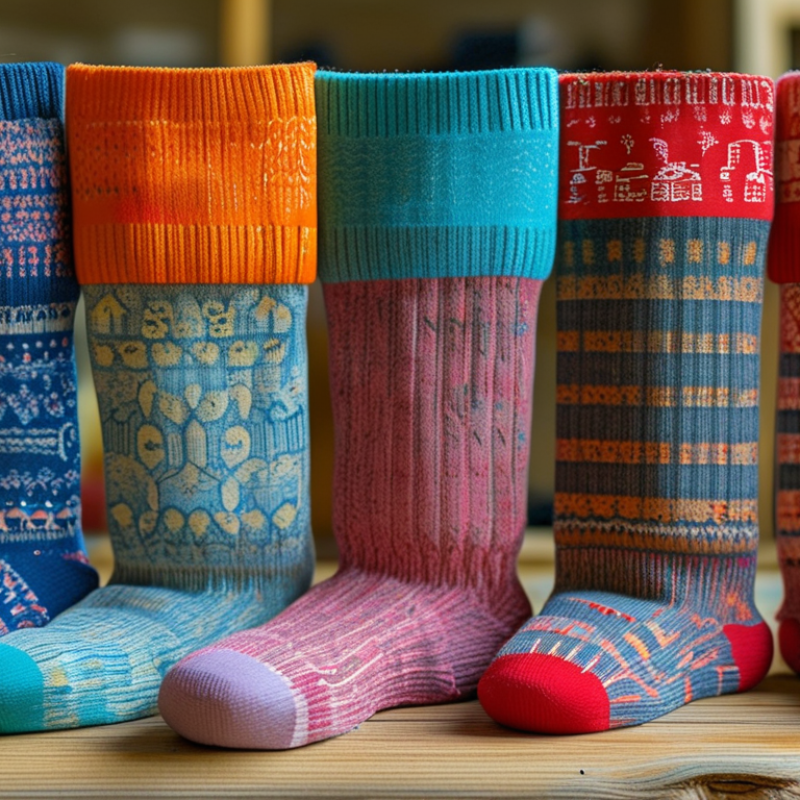
How to Choose the Best 360 Sock Printing Supplier?

Define Your 360 Sock Printing Requirements and Quality Standards

How to Choose the Best 360 Sock Printing Supplier?

Choosing a 360 sock printing supplier starts with a written product brief, not a colorful sample. Define sock sizes, yarn composition, stretch percentage, print coverage, artwork scale, order volume, and delivery dates. Specify whether the design must wrap continuously around the ankle and toe. Measure the blank sock after stretching. A relaxed template can hide white gaps during wear. It happens often.

Set measurable quality standards before requesting quotes. Ask for color tolerance, wash durability, rub resistance, registration accuracy, seam placement, and defect limits. AATCC TM61 supports accelerated laundering evaluation, while ISO 105-X12 addresses colorfastness to rubbing. Use consistent testing methods. Request three samples from separate production runs. Inspect the heel, toe, and inner leg under daylight. One attractive sample proves very little.

Material choices also need evidence. Textile Exchange’s Materials Market Report 2024 records global fiber production at 124 million tonnes in 2023, with projections reaching 160 million tonnes by 2030. This growth increases pressure to document fiber content and sourcing. Grand View Research projects double-digit growth for digital textile printing through 2030. More capacity does not guarantee better socks. Ask suppliers for fiber declarations, ink safety documents, curing records, and fabric-specific test results. A controlled pilot order is safer. I might once have approved the brightest print, but softness, recovery, and wash performance matter more after ten wears.

How to Choose the Best 360 Sock Printing Supplier?

Define your printing requirements and quality standards before comparing suppliers.

Use these practical benchmark values when evaluating 360 sock printing capabilities: at least 200 dpi for detailed artwork, a color difference of ΔE 2 or less for accurate reproduction, wash fastness of grade 4 or higher, dimensional change within 5% after washing, and a finished-product defect rate below 2%.

Compare Printing Methods, Materials, and Customization Options

Choosing the best 360 sock printing supplier starts with comparing printing methods, not just catalog prices. Full-coverage sublimation works well for colorful polyester designs because the ink bonds deeply with the fibers. It can create smooth gradients around the entire sock. Screen printing may suit simpler artwork, but alignment can become difficult near the heel and toe. Direct-to-garment options offer detail, yet results may vary on textured or darker materials.

Material affects comfort, durability, and color accuracy. Polyester usually supports vivid sublimation, while cotton blends can feel softer but may produce a less saturated image. Check the yarn composition, stretch recovery, cuff strength, and washing tests. A reliable supplier should provide physical samples, production specifications, and clear color-matching guidance. Ask how they control print placement on curved areas. Small shifts are easy to notice.

Tips: Request one sample pair first. Wash it several times. Inspect the heel, toe, and seams. Also compare customization options, such as woven labels, packaging, individual sizing, and repeat-order support. A useful supplier should explain setup limits instead of promising every design perfectly. I once assumed a brighter digital preview meant brighter socks, but the fabric changed the result. That mistake was avoidable. Share vector artwork, preferred measurements, and realistic color references before approving bulk production. Great communication matters as much as the machine.

Evaluate Supplier Experience, Production Capacity, and Technology

Choosing a 360 sock printing supplier requires more than comparing unit prices. Experience should appear in production records, not attractive samples. Ask how many years the supplier has handled stretch fabrics, repeat orders, and complex ankle-to-toe artwork. Request wash-test results, color consistency records, and defect rates. A polished sample proves little.

Production capacity needs careful measurement. According to Grand View Research, the global digital textile printing market reached approximately $2.31 billion in 2023, with strong projected growth through 2030. This growth does not guarantee reliable delivery. A supplier may advertise 50,000 pairs daily, but that figure can exclude setup time, reprints, maintenance, and quality checks. Ask for confirmed weekly capacity, average lead time, machine uptime, and peak-season performance. Smaller suppliers may provide better attention, but their backup capacity can be limited.

Technology determines whether a design remains accurate around the entire sock. Confirm that the supplier uses seamless 360-degree mapping, calibrated color management, and inspection at multiple production stages. Digital files should be checked for distortion near the heel, toe, and cuff. Textile Exchange reported global fiber production at about 124 million tonnes in 2023, showing the scale of material variation suppliers must manage. Request testing on your actual fiber blend, not a similar fabric. My own caution is simple: technical claims often sound complete, yet real performance can still disappoint. Run a small pilot order before approving full production.

Check Samples, Pricing, Minimum Orders, and Delivery Policies

How to Choose the Best 360 Sock Printing Supplier?

A strong supplier should prove quality before discussing volume. Request samples with ribbed cuffs, heel turns, and toe seams included. Inspect whether the artwork remains continuous around the sock. Check white areas, edge sharpness, stretch recovery, and wash performance after five cycles. A perfect showroom sample can mislead. Ask for an unedited production sample instead.

Pricing needs more than a unit quote. Request separate costs for artwork preparation, sampling, packaging, shipping, and color changes. Grand View Research valued the global digital textile printing market at over USD 2 billion in 2023, with strong projected growth through 2030. This growth may improve equipment access, but it does not guarantee careful production. Compare pricing at three quantities, such as 100, 500, and 2,000 pairs. Low prices can hide setup charges.

Minimum orders matter for testing new designs. A flexible supplier may accept small batches, although the per-pair cost usually rises. Confirm whether mixed sizes and designs count toward one minimum order. Smithers reports continued expansion in digital textile printing, driven partly by shorter runs and customization. Delivery policies should state production days, approval deadlines, shipping methods, and remedies for delays. Ask for a written replacement policy for mismatched colors or damaged pairs. Get everything documented. I would also test communication during sampling; slow replies often become slower after payment.

How to Choose the Best 360 Sock Printing Supplier? - Check Samples, Pricing, Minimum Orders, and Delivery Policies
Supplier Profile Recommended For Sample Options Sample Lead Time Indicative Price per Pair (USD) Typical MOQ Production Lead Time Delivery Policy Quality Checks to Confirm Key Evaluation Point
Digital Print Specialist Highly detailed artwork, gradients, photographs, and short runs Digital artwork proof
Physical pre-production sample available
3–7 business days $3.50–$7.50 for small orders; lower at volume 50–200 pairs per design 10–20 business days after artwork approval Express and standard shipping usually available; shipping cost commonly quoted separately Color accuracy, print alignment, stretch performance, wash resistance, and toe-seam placement Best choice when design detail matters more than the lowest unit price
Large-Volume Knit Manufacturer Retail programs, promotional campaigns, and repeat bulk orders Digital mock-up included
Physical sample may require a paid setup
7–14 business days $1.20–$3.00 at 1,000+ pairs 500–2,000 pairs per design or colorway 20–40 business days after sample approval Production is normally scheduled after deposit and final approval; split shipments may be negotiable Fiber composition, size grading, knitting density, color consistency, packaging, and carton count Best unit economics, but less suitable for testing many small designs
Low-MOQ Custom Supplier Startups, online stores, limited editions, and product testing 1 digital sample included
Paid physical sample recommended
5–10 business days $3.00–$6.50 for 100–300 pairs 30–100 pairs per design 12–25 business days after approval Usually offers tracked parcel shipping; confirm whether duties and taxes are included Actual pair count, logo position, size range, elastic recovery, loose threads, and packaging accuracy Best for validating demand before committing to a large order
Private-Label Program Supplier Brands needing custom labels, packaging, barcodes, and coordinated fulfillment Artwork proof
Label and packaging sample available before production
7–15 business days $2.00–$5.00 per pair, excluding special packaging 300–1,000 pairs per style 20–35 business days after all approvals May support carton labeling, warehouse delivery, and scheduled dispatch; obtain written delivery milestones Label content, barcode readability, packaging dimensions, carton strength, and final inspection records Best when branding and operational consistency are as important as the socks
Premium Sustainable-Fiber Supplier Eco-focused collections requiring documented material standards Material swatches
Physical sample with fiber documentation
10–18 business days $3.50–$8.00 per pair 200–500 pairs per design 25–45 business days after approval Documentation and certification copies should be reviewed before purchase; delivery may take longer for certified materials Fiber percentages, certification scope, dyeing method, shrinkage, colorfastness, and recycled-content evidence Best for sustainability claims that must be supported by verifiable documentation
Fast-Turn Promotional Supplier Events, campaigns, seasonal launches, and time-sensitive promotions Digital proof required
Physical sample may be skipped for urgent orders
2–5 business days for digital approval $2.50–$5.50 for 100–500 pairs 100–300 pairs per design 7–15 business days after approval Expedited production and courier shipping may be available at an additional charge; request a guaranteed dispatch date Artwork approval record, size assortment, print position, color tolerance, and pre-shipment photographs Best for deadlines, but confirm whether speed affects sampling and inspection procedures
Indicative industry ranges for custom 360-degree printed socks. Actual pricing, minimum orders, production times, freight charges, taxes, and certification requirements vary by material, size, artwork complexity, packaging, order quantity, destination, and shipping method. Request a written quotation and an approved pre-production sample before placing a bulk order.

Verify Communication, Certifications, Reviews, and After-Sales Support

Choosing a 360 sock printing supplier starts with the first conversation. Ask for a production timeline, artwork checklist, sample policy, and escalation contact. Fast replies are useful, but precise replies matter more. Every answer should match the quotation and later sample. During practical sourcing, vague promises often create costly rework. Do not ignore small inconsistencies. The Edelman Trust Barometer 2024 reported business as the most trusted institution globally, with 62% trust. Still, trust must be tested through written records, clear deadlines, and accountable communication.

Verify certification details instead of accepting logo images. Request the certificate number, expiry date, issuing body, and covered production site. The ISO Survey 2023 recorded more than 1.2 million ISO 9001 certificates worldwide, showing how common quality certification has become. Yet certification does not guarantee perfect color matching or flawless toe seams. Check recent customer reviews, especially comments about delays, replacements, and response quality. BrightLocal’s 2023 Local Consumer Review Survey found that 98% of consumers read online reviews for local businesses. Reviews are not proof alone, but repeated patterns deserve attention.

Tips: Ask for two recent production samples and compare stretch, print alignment, washing instructions, and packaging. Confirm who pays for defective units. After-sales support should include a response time, replacement process, and photo-based inspection method. A supplier may sound professional before payment, then become slower afterward. That risk is easy to underestimate. Test the support process with one small order before committing to larger volumes.

Enquire Today

"*" indicates required fields