How to Choose the Best Drying Oven Manufacturers
Choosing among Drying Oven Manufacturers is a process decision, not just a price comparison. The International Energy Agency’s Energy Efficiency 2023 report estimates that industry accounts for roughly 37% of global energy consumption. That makes heat efficiency, cycle time, and insulation worth examining alongside the purchase price. Small differences matter.
Start with the material, moisture load, batch size, and required temperature range. A cabinet oven may suit small, varied batches, while a conveyor system can support continuous production. Ask manufacturers for temperature-uniformity data, airflow details, and test conditions—not simply a maximum temperature. A number without its test method tells you little. The U.S. Department of Energy’s Better Plants resources also emphasize process heating as an important opportunity for industrial energy savings.
Compare usable chamber dimensions, control accuracy, exhaust options, and cleaning access. Request references from facilities with similar products and operating schedules. Check what commissioning, operator training, spare parts, and technical support actually include. A polished brochure can still hide weak airflow evidence. I would not treat a certificate or an impressive efficiency claim as proof of performance; confirm the scope and ask how the result was measured.
The best Drying Oven Manufacturers should explain trade-offs clearly and provide practical documentation, including acceptance-test records. Consider the full operating cost, not only the quote. Requirements differ by product, and specifications can be easy to misread. Use a representative sample and a defined test cycle where possible. That extra check may reveal uneven drying before installation turns it into an expensive problem.
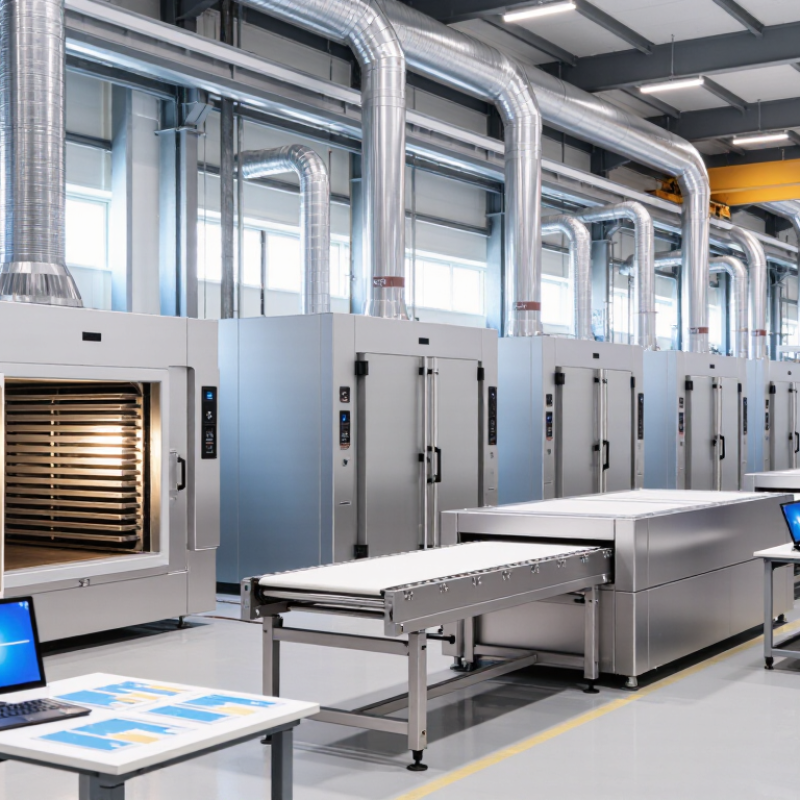
Define Required Capacity and Temperature Range, Commonly 50–300°C
Before comparing drying oven manufacturers, translate your process into usable chamber volume and a defined temperature range. A range of 50–300°C is common, but it does not prove the oven will hold your setpoint evenly. Specify your lowest and highest operating temperatures, along with the temperatures used for routine batches. Estimate load size using actual trays, containers, and space needed for airflow. Fit matters. A chamber packed to its limit may dry slowly or develop temperature differences. Allow for future batches, but remember that excess capacity can take longer to heat and use more energy.
Ask manufacturers for usable internal dimensions, temperature uniformity data, and recovery time after the door opens. Check whether performance figures apply to an empty chamber or a representative loaded test; that difference matters. Confirm that controls can maintain your working setpoints, not merely reach the top of the stated range. If products are sensitive to heat, ask about sensor placement and temperature calibration. A neat specification sheet can still leave practical questions unanswered. Share your sample load and operating cycle, then request recommendations in writing. If your process is not fully established, be cautious about choosing capacity from a single trial batch; the estimate may need revision.
Compare Temperature Uniformity and Recovery Data Under ASTM E145
When comparing drying oven manufacturers, request temperature-uniformity maps and recovery logs tested against ASTM E145. The standard distinguishes oven types and performance classes, so compare equivalent configurations and setpoints. A single advertised tolerance tells little. Ask for probe locations, load condition, stabilization time, and the recorded minimum and maximum temperatures.
For each setpoint, compare the measured temperature spread and recovery time after the door opens. A useful report records how long the chamber takes to return to its stated operating band, with the same load and door-opening procedure for every candidate. ASTM E145 provides the test framework; NIST Technical Note 1297 explains why measurement uncertainty belongs in reported results. Request calibration details and uncertainty, not just a polished graph.
Still, numbers can flatter. An empty-chamber map may not predict a crowded shelf of glassware or wet samples. Look for raw readings across several runs, including a realistic load. Compare data at your working temperature, not only the oven’s most favorable setpoint. If recovery is reported without the opening duration or load, the figure is hard to judge. Ask for the missing conditions.
How to Choose the Best Drying Oven Manufacturers: Compare Temperature Uniformity and Recovery Data Under ASTM E145
Lower peak-to-peak temperature variation and shorter recovery time may indicate more consistent performance. These illustrative values are not manufacturer test results or ASTM E145 certification data. For a fair comparison, review verified reports using the same oven type, set point, load, measurement locations, and recovery protocol.
Check Airflow, Load Size, and Rated Power (kW) Against Process Needs
How to Choose the Best Drying Oven Manufacturers
Check Airflow, Load Size, and Rated Power (kW) Against Process Needs
A drying oven should match the material, batch size, and required drying time. Ask manufacturers how air moves through a fully loaded chamber, not just an empty one. Shelves can block circulation, leaving items near the door cooler than those at the back. Request temperature-uniformity data under conditions close to your actual process. Small details matter.
Tips: Share your typical load’s dimensions, weight, moisture level, and container type. Ask whether airflow can be adjusted, and whether the supplier can run a sample test. A simple test may reveal gaps that a polished specification sheet misses.
Check usable chamber size, not only its advertised capacity. Leave room around trays for air to pass. Rated power, shown in kW, indicates electrical demand; it does not alone prove fast or even drying. Ask about heat-up time, recovery after loading, insulation, and power requirements at your site. Then compare these figures with your production schedule.
I once focused too much on chamber volume; a crowded load taught me that airflow space can be just as important. Ask for operating instructions and service support, too. Good answers should be specific to your load, not generic promises.
Assess Calibration Traceability, Warranty, and Service Coverage
When comparing drying oven manufacturers, calibration paperwork deserves more than a quick glance. Ask whether temperature readings can be traced through documented standards to a recognized national or international reference. Request a sample certificate, not just a promise. It should identify the sensor, calibration points, results, uncertainty, and date. Check points near your actual operating range; a certificate covering only one convenient temperature may tell you little.
Test the process. A shelf loaded with glassware can heat differently from an empty chamber. Ask how mapping is performed, how many sensors are used, and whether the report shows hot and cold locations. This detail matters. Calibration traceability supports confidence, but it does not guarantee uniformity in your specific setup. You may need to repeat checks after installation, especially if airflow or load patterns change.
Read the warranty before comparing prices. Confirm coverage for heaters, controllers, sensors, labor, and travel, plus the response time for service requests. Some terms sound generous until routine wear parts are excluded. Ask where technicians are based and whether remote troubleshooting is available. A nearby service team can reduce downtime; written escalation steps help too. Keep the answer in writing. I would also ask about parts availability, though forecasts can be imperfect. A supplier that admits limitations may be more useful than one offering easy assurances.