
Why Choose a Natural Gas Steam Boiler for Industry?

A Natural Gas Steam Boiler can support steady process heat in food production, textiles, chemical processing, and other industrial settings. Its value depends on the job. A plant running clean steam lines for long shifts has different needs from a facility with sharp changes in demand. Fuel availability, steam pressure, water quality, emissions controls, and maintenance access all shape the decision.

The choice is practical. A well-matched boiler can deliver dependable steam and respond efficiently to changing loads. A poorly sized unit may cycle too often, waste fuel, or struggle during peak demand. Operators should compare total operating costs, expected service life, burner performance, and the support available from qualified technicians. Look closely at the details: condensate return, feedwater treatment, insulation, and the space needed for inspections. Small oversights matter.

Experience matters here. Boiler selection should be checked against actual load data, not only a brochure’s headline efficiency. A site assessment can reveal constraints that are easy to miss on paper. This article will examine the main benefits, trade-offs, and selection factors for industrial users. No source article or verified expert quotation was provided, so I will not invent a specialist’s name or words. A sourced quotation can be added once its accuracy and attribution are confirmed.
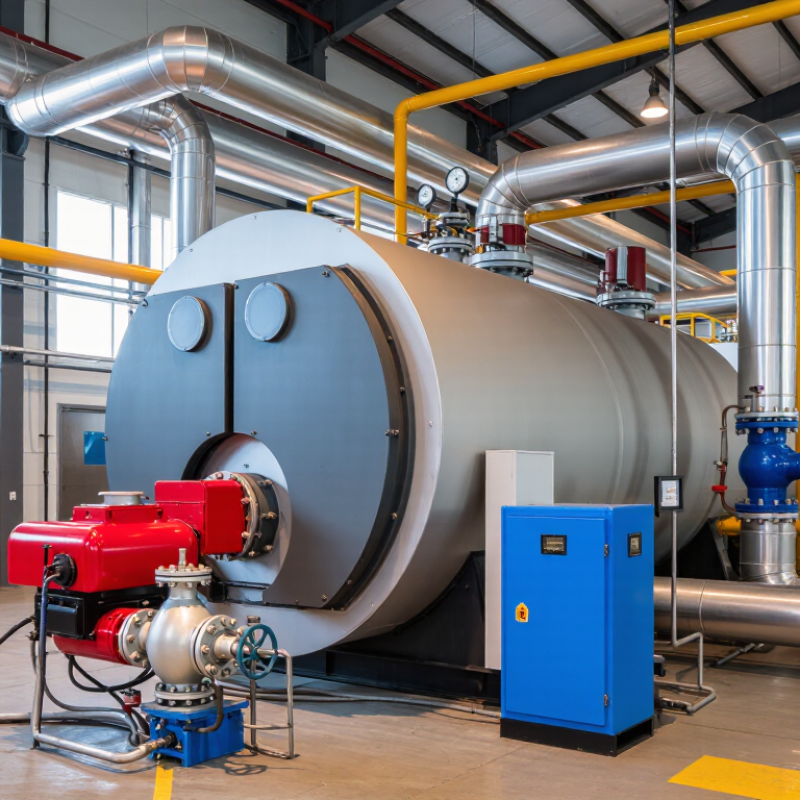
Why Choose a Natural Gas Steam Boiler for Industry?

How Natural Gas Boilers Convert Fuel into Industrial Steam

A natural gas steam boiler turns fuel into useful heat through controlled combustion. A burner mixes natural gas with air and ignites it inside the furnace. The flame heats metal surfaces around the water-filled pressure vessel. Hot combustion gases then pass through tubes, transferring more heat before leaving through the flue.

As water absorbs energy, its temperature rises until steam forms. In many industrial boilers, steam separates from water in a drum before entering the plant’s distribution lines. Not magic. Feedwater must be treated and supplied steadily, while controls adjust fuel and air to maintain the required pressure. Too much excess air can carry heat up the stack; too little can impair combustion.

The process looks simple on a diagram, but real operation is less tidy. Production demand can change quickly, and the boiler must respond without large pressure swings. Operators monitor burner conditions, water level, flue-gas readings, and blowdown. Scale on heat-transfer surfaces can reduce efficiency, even when the burner appears to run normally. No boiler is perfectly efficient. Regular inspection and careful tuning help reveal losses that routine operation may otherwise hide.

Which Boiler Designs Match Plant Loads and Steam-Pressure Needs

A boiler should be selected around the plant’s actual steam profile, not just its highest recorded demand. A fire-tube design often suits steady, moderate-pressure service, such as process heating or laundry operations. Its large water volume can buffer short demand changes. That can help. But it may respond more slowly when loads swing sharply.

Water-tube boilers are commonly considered for higher pressures, larger capacities, or faster load changes. They contain less water in the heated circuits, so control response can be quicker. The right choice still depends on the required output, feedwater quality, and operating pattern. Check the plant’s pressure at the point of use, too. A boiler-room gauge reading alone may miss losses through long or undersized steam lines.

For variable demand, several smaller boilers may track changing loads better than one large unit. Sequencing controls can bring units online as demand rises, while preserving a standby margin. Compare turndown range, start-up frequency, and expected peak duration—not only rated capacity. In practice, a tidy load spreadsheet can still miss brief production surges. Reviewing shift records and pressure trends with a qualified boiler professional helps expose those gaps before equipment is specified.

How ASME Section I Uses 15 psig to Define Power Boilers

Why Choose a Natural Gas Steam Boiler for Industry?

A natural gas steam boiler can provide steady heat for process lines, sterilizers, and wash systems. But fuel choice does not determine its ASME classification. Pressure and intended service matter more.

ASME Section I generally covers power boilers that generate steam or vapor above 15 psig. A boiler operating at 100 psig, for example, falls above that threshold; a steam heating boiler designed for 15 psig or less is generally addressed by a different code section. That number matters. The 15 psig point is a scope boundary, not a measure of boiler quality or efficiency.

Real installations can be less tidy. Pressure controls, safety valves, and the boiler’s stamped design pressure all deserve careful review; normal operating pressure alone may not tell the whole story. Local requirements can also affect which rules apply. A plant engineer should confirm the boiler’s service, design documentation, and jurisdictional requirements with qualified professionals. Small details count: a pressure setting changed during commissioning can prompt questions about whether the equipment still matches its approved design.

Why Fuel Choice Matters: EIA Puts Gas at About 53 kg CO₂/MMBtu

For an industrial boiler, fuel choice sets a large part of its direct carbon profile. The U.S. Energy Information Administration’s Carbon Dioxide Emissions Coefficients lists natural gas at 52.91 kg CO₂ per MMBtu of heat input, commonly rounded to 53. The U.S. Environmental Protection Agency’s GHG Emission Factors Hub reports a closely comparable factor. These are combustion estimates, not full lifecycle footprints. Important distinction.

Per unit of heat input, natural gas releases less CO₂ at combustion than coal or fuel oil, according to EIA’s fuel coefficients. But a boiler’s actual emissions also depend on efficiency and operating conditions. A poorly tuned burner can waste fuel through excess air or high stack temperatures. A stable steam load, clean heat-transfer surfaces, and regular combustion checks help keep fuel use closer to the design rate. Measure it.

The U.S. Department of Energy’s Steam System Survey Guide recommends assessing the wider system, including distribution losses and condensate return. That matters on a plant floor: a leaking steam trap or uninsulated valve can quietly increase demand. Gas’s roughly 53 kg figure is useful for comparing fuels on a consistent heat-input basis, but it does not promise low emissions in every installation. Boiler efficiency, maintenance, and the electricity or fuel used upstream still deserve scrutiny. One limitation remains: a single emissions factor cannot describe every site’s performance.

Why Choose a Natural Gas Steam Boiler for Industry?

Why fuel choice matters: natural gas emits about 53 kg of CO₂ per MMBtu of fuel input.

Natural gas has a lower direct-combustion CO₂ emission factor per unit of heat input than distillate fuel oil or coal. Values are fuel-based emission factors, not boiler-efficiency or lifecycle comparisons. Source: U.S. Energy Information Administration (EIA).

How Controls and Condensate Return Shape Boiler Performance

A natural gas steam boiler depends on controls as much as its burner. A pressure transmitter signals when steam demand changes. The burner then adjusts its firing rate to maintain the target pressure without needless cycling. Feedwater controls keep the boiler level within its operating range. Flame safeguards and low-water cutoffs provide essential protection; they need regular testing, not just a glance at the control panel. Small details matter.

Condensate return also shapes performance. Returning hot condensate reduces the energy needed to heat incoming feedwater and can lower water-treatment demand. Yet return is only useful when the condensate is clean and the piping works properly. A failed steam trap may waste live steam, while a contaminated return can carry unwanted material back to the boiler. Operators can track return temperature, water quality, and makeup-water volume to spot changes early. Insulated lines help retain heat, but insulation can hide leaks or corrosion. One caveat: readings need context. A sudden rise in makeup water may point to a leak, a process change, or a faulty meter, so operators should check the system before adjusting controls.

Why Choose a Natural Gas Steam Boiler for Industry? - How Controls and Condensate Return Shape Boiler Performance
Performance dimension Data or operating reference How it affects boiler performance Control or monitoring approach
Steam pressure and saturation temperature At approximately 5 bar gauge, saturated steam is about 159°C. At approximately 10 bar gauge, it is about 184°C. Steam pressure determines the saturation temperature and influences the temperature available to the process. Use a pressure controller and a correctly sized pressure-relief system. Set operating pressure to the process requirement and applicable codes.
Condensate return temperature Water’s specific heat is approximately 4.18 kJ/(kg·K). Raising 1 kg of water from 20°C to 80°C represents about 251 kJ of sensible heat. Returning hot condensate reduces the amount of cold makeup water that must be heated. Measure return temperature and flow. Insulate condensate lines where appropriate and investigate heat loss or contamination.
Illustrative condensate heat recovery For 1 tonne per hour returned at 80°C instead of replaced by 20°C makeup water: approximately 251 MJ/h, or 69.7 kW, of sensible heat is returned. Calculation uses 1,000 kg/h × 4.18 kJ/(kg·K) × 60 K. This is recovered heat in the water stream, not a guaranteed fuel-saving figure. Actual fuel savings depend on boiler efficiency, system losses, and operating conditions. Compare measured condensate flow and temperature with makeup-water flow and temperature; assess the boiler and feedwater system as a whole.
Condensate return rate Return rate (%) = returned condensate mass ÷ steam-system condensate production × 100. For example, 7 tonnes per hour returned from 10 tonnes per hour produced is 70%, assuming the figures use the same system boundary. A higher usable return rate generally reduces makeup-water demand and the energy needed to heat replacement water. Track condensate flow and makeup-water flow. Check for steam traps, leaks, process contamination, and condensate that cannot be recovered.
Boiler water level The operating water level must remain within the boiler manufacturer’s specified range; no universal setpoint applies to every boiler. Stable level control supports reliable steam production. Low-water conditions can expose heated surfaces; excessive carryover can send water with the steam. Use the specified level-control and independent low-water protection devices. Inspect, test, and maintain them according to applicable requirements.
Combustion and burner control Natural-gas combustion requires the correct air-to-fuel ratio across the burner’s firing range. The required settings depend on burner design and operating conditions. Properly adjusted combustion supports stable firing and helps limit excess air and incomplete combustion. Commission and periodically test the burner using suitable combustion measurements. Oxygen-trim controls, where fitted, adjust air-fuel operation in response to measured flue-gas oxygen.
Feedwater temperature Feedwater temperature varies with condensate return, makeup-water temperature, and any feedwater-heating equipment. Warmer feedwater requires less additional heat to reach boiling conditions than colder feedwater. Monitor feedwater temperature and flow. Coordinate condensate recovery, deaeration, and feedwater heating to the plant design.
Blowdown and dissolved solids Blowdown removes concentrated boiler water. The appropriate rate depends on feedwater quality, boiler limits, and the required water chemistry. Too little blowdown can allow dissolved solids to concentrate; excessive blowdown discards hot water and increases makeup-water demand. Use water-treatment guidance and boiler-water testing. Conductivity-based automatic blowdown can control dissolved-solids concentration when properly configured.
Interpretation of figures Thermodynamic values are approximate reference values. Actual operating results depend on pressure, water chemistry, equipment design, control settings, maintenance, and the condensate-system layout.

Enquire Today

"*" indicates required fields