
Choosing among China’s leading Laser Cut Parts manufacturers takes more than comparing prices. A supplier may cut a stainless-steel bracket cleanly, yet struggle to hold the same dimensions across a large batch. This guide examines ten manufacturers through practical factors: material range, cutting capability, inspection methods, communication, and delivery consistency. It is a starting point, not an independently audited ranking.
Quality expert W. Edwards Deming offered a principle relevant to production: “Quality comes not from inspection, but from improvement of the production process.” For buyers, that means asking how a factory controls the process—not just whether it owns a modern laser cutter. Ask about material certificates, first-article checks, burr removal, and how changes to a drawing are recorded. A clear answer matters.
Details matter. A 2 mm stainless-steel panel with narrow slots needs different checks from a thick carbon-steel frame. Request a sample, a marked-up drawing, and evidence of dimensional inspection before committing to volume. Short lead times can look attractive. Verify them against your actual order.
This comparison will help you build a shortlist and prepare better questions for each supplier. Still, no article can confirm how a factory will perform on your exact part. I would treat any ranking cautiously; a polished website is not proof of repeatable results. A production trial may reveal more.
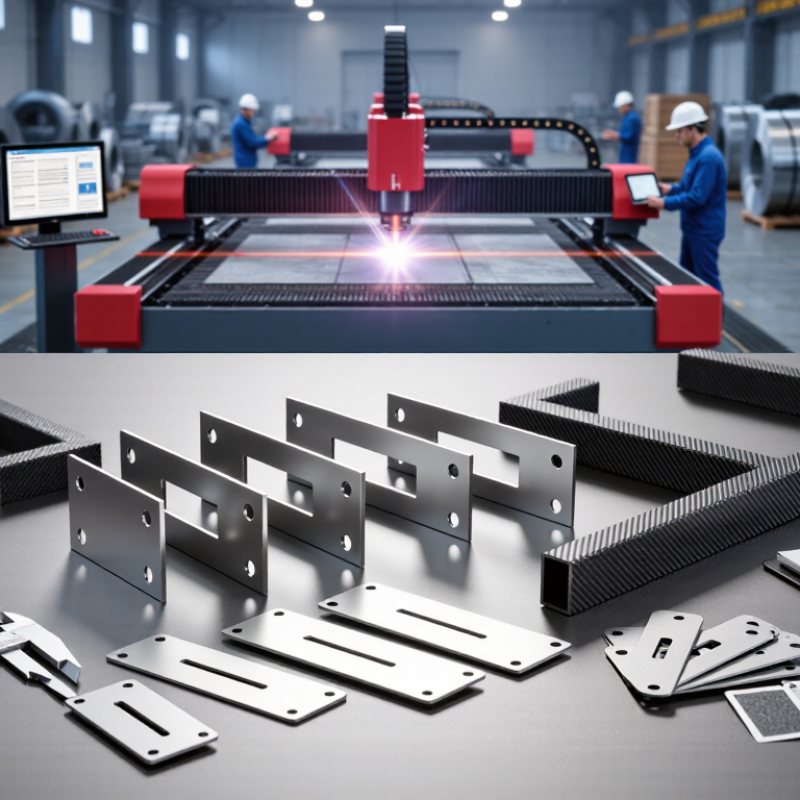
A laser-cut part starts with a CAD drawing, but the drawing alone cannot guarantee a clean edge. Engineers check material grade, thickness, tolerances, and small features before arranging parts on a sheet. The machine focuses a high-energy beam and uses assist gas to clear molten material. Power, speed, focus, and gas pressure must suit the material. Too much heat can leave burrs or discoloration. Too little can cause incomplete cuts. Small details matter.
After cutting, operators inspect dimensions, remove burrs, and separate parts from the sheet. Some components also need forming, welding, or finishing. Grand View Research estimated the global laser cutting machine market at USD 5.8 billion in 2023, with a projected 7.5% annual growth rate from 2024 to 2030. This suggests wider industrial adoption, but it does not guarantee part quality. A common weakness is assuming one standard tolerance suits every feature. It may not.
Tips: Request first-article inspection for critical dimensions. Share material details and a fully dimensioned drawing. Check narrow slots, hole sizes, and heat-sensitive corners. A polished sample can hide production variation.
A credible laser-cut parts supplier should prove process control, not just display a large machine list. Ask for sample inspection records showing dimensions, flatness, burr condition, and cut-edge quality. Check whether the stated tolerance matches your drawing and material thickness. Request material certificates and traceability records, then compare them with the parts delivered. A polished sample can hide inconsistent production.
The ISO Survey 2022 counted 1,265,216 ISO 9001 certificates worldwide across 189 countries and economies. Certification can indicate a documented quality system, but it does not guarantee every part meets specification. Review corrective-action records and ask how operators handle out-of-tolerance cuts. Small details matter. A checklist can still miss things.
Capacity and communication deserve equal scrutiny. Deloitte’s 2024 manufacturing outlook reported that 86% of surveyed executives viewed smart manufacturing as a competitiveness driver over the next five years. Ask whether the supplier tracks machine downtime, inspection results, and order status digitally. Then verify the answer with a sample production report. Confirm lead times against actual recent orders, not ideal estimates. I would also test a small batch before committing to a larger run; it adds time, but often exposes gaps early.
China’s Top 10 Laser-Cut Parts Manufacturers should be judged by more than machine count or online visibility. Strong candidates show consistent cutting quality, documented inspection, and practical experience with the buyer’s material and thickness range. A clean sample edge matters. So does a readable inspection record.
The International Federation of Robotics’ World Robotics 2024 report says China installed 276,288 industrial robots in 2023, about 51% of global installations. This points to a deep automation base, but it does not prove that any particular parts supplier is reliable. Buyers should check how manufacturers control heat distortion, burrs, and dimensional variation across repeat orders. Ask for sample parts, tolerance records, and the material certificates relevant to the job.
A useful top-ten comparison should also consider production flexibility, delivery performance, and engineering support. Can the supplier handle a small prototype run, then repeat the same geometry at volume? Are drawings reviewed before cutting, or only after a defect appears? These details can expose real differences between factories. Yet rankings have limits: public data rarely reveals reject rates or on-time delivery, and a polished factory tour may not reflect daily production. Verify claims with a controlled trial order.
Choosing a laser-cutting supplier is less about a ranking and more about fit. A shop handling thin stainless-steel panels may not suit thick carbon-steel brackets. Ask which materials and thicknesses it processes regularly, not just what its equipment can theoretically cut. A sample edge tells you plenty: look for burrs, heat discoloration, and consistency across repeated parts. Small details matter.
Manufacturers may specialize in sheet-metal enclosures, decorative panels, machinery components, or precision parts for electronics. Their strengths depend on more than laser power. Check whether they provide nesting, bending, welding, surface finishing, and assembly, since fewer handoffs can simplify production. Also ask how they verify dimensions. A clear inspection plan, calibrated measuring tools, and traceable production records are stronger evidence than broad quality claims.
Request a quotation using the same drawings, material grade, finish, and order quantity for each candidate. Compare lead times and packaging, too; parts can be accurate and still arrive scratched. One point is easy to miss: a low prototype price may not predict production costs. Ask how setup, material yield, and revisions affect pricing. No supplier is perfect, and a polished brochure cannot replace a measured first article.
When choosing a laser-cut parts supplier in China, compare production evidence, not just quotes. Grand View Research estimated the global laser cutting machine market at USD 5.12 billion in 2023, reflecting broad industrial demand. That figure does not prove any supplier’s quality. Ask for material certificates, machine capabilities, inspection records, and a sample made from your actual drawing. Check cut-edge roughness, hole position, burrs, and whether the stated tolerance applies to the full part or only selected features.
Tips: Send a drawing with clear dimensions and tolerances. Ask how the supplier checks them, and request a first-article inspection report. Confirm sheet thickness, alloy grade, finish, packaging, and lead time in writing. For repeat orders, ask how changes to material batches or machine settings are recorded. A neat sample is useful, but it cannot guarantee consistent production. Small details matter.
Before committing, test the communication process with one technical question: for example, how will a narrow slot behave in 6 mm stainless steel? A capable team should explain likely limits and suggest options without promising everything. Compare the sample with your CAD file using measurable points, then discuss any mismatch. I would still leave room for adjustment; drawings can miss practical details, and supplier paperwork may not reveal every edge defect.
A practical, non-ranked checklist of ten factors for evaluating laser-cut parts suppliers. Confirm capabilities against your material, drawing, finish, and production requirements.
| No. | Evaluation dimension | What to assess | Evidence to request | Practical selection guidance |
|---|---|---|---|---|
| 1 | Material capability | Experience with your specified grades of carbon steel, stainless steel, aluminum, or other sheet materials. | Material specifications, traceability records where required, and a sample made from the requested grade and thickness. | Check grade, thickness, surface condition, and material substitution rules before placing an order. |
| 2 | Cutting capacity | Available laser processes, workable sheet sizes, and cutting limits for the materials and thicknesses in your part mix. | A capability list tied to material type and thickness, plus confirmation that the required sheet format fits the equipment. | Do not rely on a single maximum-thickness figure; cutting capability varies by material, machine, geometry, and required edge quality. |
| 3 | Dimensional control | Ability to inspect critical dimensions, hole locations, profiles, and flatness against your drawing and tolerances. | Inspection plan, sample measurement report, and details of measuring equipment and calibration controls. | Specify tolerances on the drawing; agree in advance how critical dimensions will be measured and reported. |
| 4 | Edge quality and burr control | Cut-edge consistency, dross or burr removal, heat effects, and suitability of edges for assembly or coating. | Representative cut samples, stated deburring method, and acceptance criteria for edge condition. | Use sample approval to define acceptable edge condition; requirements depend on function, safety, and downstream finishing. |
| 5 | Drawing and engineering support | Ability to review CAD files, flag manufacturability issues, and manage drawing revisions and clarification requests. | A sample design-for-manufacturing review and a documented process for revision control. | Provide controlled 2D drawings and compatible 3D or cutting files where needed; agree which document governs if files differ. |
| 6 | Secondary operations | Access to required bending, tapping, countersinking, welding, deburring, or surface finishing, either in-house or through managed partners. | Process list, responsibility boundaries, inspection records, and samples of completed parts where relevant. | Clarify who controls outsourced processes and who is responsible for final inspection and nonconforming work. |
| 7 | Quality management | Documented controls for incoming material, production checks, final inspection, corrective action, and record retention. | Quality procedures, example inspection records, and any applicable current certification with its scope verified. | A certification is useful context, but confirm that its scope and the supplier's actual controls match your order requirements. |
| 8 | Capacity and lead-time reliability | Production planning, workload visibility, repeat-order support, and ability to meet your required delivery schedule. | A written production schedule, stated capacity assumptions, and updates on material availability and order status. | Agree lead time from drawing approval and material confirmation, and define how schedule changes will be communicated. |
| 9 | Packaging and export readiness | Protection against scratches, corrosion, deformation, and transit damage, plus clear shipment documentation. | Packaging proposal, carton or pallet details, part identification method, and a sample packing list. | Set packaging, labeling, delivery terms, and responsibility for freight and customs documentation before production. |
| 10 | Quotation transparency and total cost | Clarity on material, cutting, finishing, tooling or setup, packaging, shipping, taxes, and minimum order quantities. | An itemized quotation with currency, validity period, payment terms, assumptions, and exclusions. | Compare like-for-like specifications and landed cost; confirm whether scrap, inspection, and rework are included. |
Accreditations
ISO 9001 Quality Management
HSE Management Compliant
Products and services comply with relevant Australian (AS) and international (ISO, etc.) Standards.
"*" indicates required fields