
Top 10 Engine Cylinder Block Manufacturers Worldwide

Engine cylinder blocks form the structural core of an engine, supporting the crankshaft, pistons, and cooling passages. Their design affects durability, heat management, weight, and manufacturing cost. For automakers and equipment builders, choosing a supplier is not just a price comparison. It requires attention to material options, machining capability, production scale, and quality controls. Details matter.

This guide introduces ten notable Engine Cylinder Block manufacturers worldwide and explains the capabilities that distinguish them. Their work spans cast iron and aluminum designs, from heavy-duty commercial engines to lighter passenger-vehicle applications. A close look at each company can reveal its product focus, manufacturing strengths, and role in the global supply chain. Useful checks include stated production expertise, application range, and evidence of consistent process control; these details help readers compare suppliers without treating marketing claims as proof. Trade-offs remain. A manufacturer suited to high-volume vehicle programs may not fit a specialist engine project, and public information can vary in depth. No list is perfect. The aim here is a practical starting point, not a substitute for technical review, sample validation, or direct supplier evaluation.
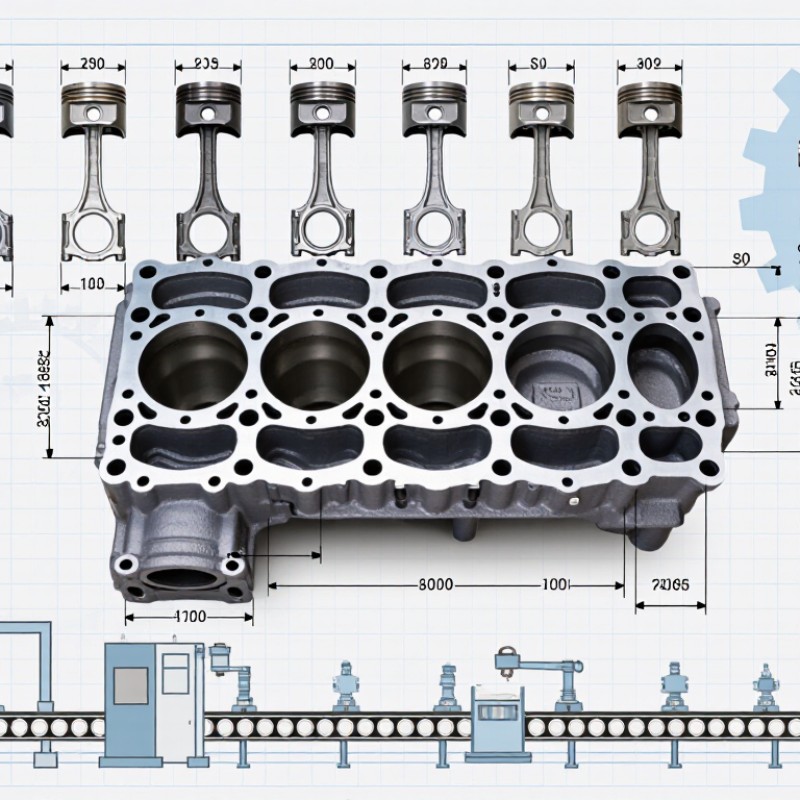
Top 10 Engine Cylinder Block Manufacturers Worldwide

Global Market Context: OICA Reports 93.5 Million Vehicles Produced in 2023

OICA reported that 93.5 million vehicles were produced worldwide in 2023. The figure shows the scale of the market served by automotive suppliers, including makers of engine cylinder blocks. It is a production count, not a direct measure of cylinder-block demand. Vehicle types, engine designs, and powertrain choices vary, so the number needs careful reading.

For manufacturers, such a large output makes consistency important. A cylinder block must meet tight dimensional requirements, from bore spacing to mounting surfaces. On a factory floor, small differences in casting quality or machining can create costly inspection work. Yet vehicle production totals alone cannot tell us which materials, processes, or suppliers performed best. That distinction matters.

The OICA figure also describes one year, not a guaranteed trend. Production can shift across regions and vehicle categories, affecting supplier capacity and planning. A useful comparison of manufacturers should therefore look beyond headline output. Consider process control, traceability, delivery reliability, and the ability to handle different specifications. The data offers context, not a ranking. It leaves some questions open, which is easy to overlook.

Cylinder Block Fundamentals: 4-, 6-, and 8-Cylinder Configurations

Cylinder count shapes a block’s size, stiffness, cooling passages, and manufacturing complexity. A four-cylinder inline block is compact, with four bores arranged in one row. It suits tight engine bays, but its longer crankshaft and firing intervals can make vibration control important. A six-cylinder inline design is longer, while a V6 shortens the package by splitting cylinders across two banks. The layout changes access to the cylinder heads and exhaust paths, too. Small details matter.

An eight-cylinder V-layout places four cylinders on each bank. Its shorter block can fit where a straight-eight would not, but the extra cylinders add weight, friction surfaces, and cooling demands. In practice, bore spacing, deck height, and coolant-jacket design often matter as much as the cylinder count. The count alone is not a quality score. That trade-off is not tidy.

Efficiency targets also shape block decisions. The U.S. Environmental Protection Agency’s 2024 Automotive Trends Report reports average new-vehicle fuel economy of 27.1 miles per gallon for model year 2023. That fleet-wide figure does not compare cylinder layouts directly, but it shows the pressure to balance output with fuel use. Engineers may reduce displacement, adjust bore and stroke, or use lighter materials; each choice affects heat flow and durability. A casting can look robust on a drawing and still need careful testing around thin coolant passages.

Materials and Manufacturing: Cast Iron, Aluminum, Casting, and Machining

Engine-block material choices balance mass, stiffness, heat flow, and production cost. Cast iron is dense but offers strong vibration damping and wear resistance around cylinder bores. Aluminum is much lighter, yet expands more with heat and may need iron liners or reinforced bore surfaces. The American Foundry Society’s 2023 World Casting Production Census reports roughly 110 million metric tonnes of castings worldwide in 2022. That total covers many industries, not engine blocks alone, but it illustrates casting’s enormous industrial scale.

Casting quality sets the limits for later machining. Foundries control metal temperature, mold filling, and solidification to reduce shrinkage and porosity. Machining then brings the deck, bearing saddles, and cylinder bores to precise dimensions. Small flaws matter. A tiny pore near a water jacket can become a leak after machining exposes it. Still, lighter is not automatically better; the right choice depends on operating loads, cooling design, and durability testing.

Tips: Ask suppliers for material specifications, casting inspection methods, and machining tolerances. Check bore geometry after thermal testing, not only at room temperature. For aluminum blocks, review how the bore surface handles wear and heat; for iron, consider the added mass and machining time. One detail is easy to overlook: production consistency matters as much as the material name.

Top 10 Manufacturers Compared by Capacity, OEM Reach, and Regional Footprint

A useful comparison of the top 10 engine cylinder block manufacturers starts with capacity, but stated capacity can mislead. Some figures describe total casting output; others cover only one plant or product family. The OICA reported 93.5 million motor vehicles produced worldwide in 2023, up from 85.0 million in 2022. That scale signals a large manufacturing base, not a direct forecast for cylinder blocks: vehicle output includes electric models and different engine designs. Capacity needs context.

OEM reach is best judged by verified production programs, machining capability, and supply locations—not customer lists alone. A block that leaves a foundry unfinished is not equivalent to a fully machined component ready for assembly. Regional footprint matters, too. Nearby plants can shorten delivery routes and support local production, while a concentrated network may face disruption when one site is constrained. The IEA estimated nearly 14 million electric-car sales in 2023, about 18% of global car sales. The shift complicates comparisons between manufacturers serving combustion-engine programs and those with broader component portfolios. Look for disclosed plant capacity, utilization, and regional coverage; public figures are often uneven, so rankings deserve a second look.

Top 10 Engine Cylinder Block Manufacturers Worldwide — Compared by Capacity, OEM Reach, and Regional Footprint
Profile Production Capacity OEM Reach Regional Footprint Typical Cylinder-Block Capabilities Comparison Note
01 — Global multi-region foundry group Company-wide engine-block output is not consistently disclosed in comparable public units. Supplies multiple vehicle and powertrain manufacturers; programs vary by plant and region. Operations across more than one major automotive region. High-volume cast components; machining and finishing may be available at selected sites. Broad footprint can support regional sourcing, but capacity must be verified at plant level.
02 — Aluminum powertrain casting specialist Public capacity figures are generally reported by facility or product family, not as a comparable block-only total. Typically serves automotive OEM programs and other powertrain customers. Primarily established automotive manufacturing regions, with customer-dependent coverage. Aluminum engine structures and related powertrain castings; process capability depends on the site. Relevant where weight reduction and aluminum powertrain expertise are priorities.
03 — Large-scale integrated casting and machining supplier No standardized public figure for annual cylinder-block capacity. Can support multi-program supply, subject to awarded contracts and available production lines. Manufacturing presence concentrated around major vehicle-production markets. Casting, machining, inspection, and component assembly may be integrated within the supply chain. Integration can reduce logistics between production steps; confirm the scope offered by each plant.
04 — Regional automotive foundry group Capacity is typically disclosed at site level, if disclosed at all. Often has strong relationships with OEMs and Tier 1 suppliers in its home market. Primarily domestic or neighboring-country coverage. Production of engine blocks and other cast automotive components, depending on tooling and process capability. Regional proximity may support shorter supply routes and local program requirements.
05 — Iron-casting and heavy-duty engine supplier Comparable block-specific annual capacity is not generally available as a single public metric. Reach may include commercial-vehicle, industrial-engine, and off-highway customers. Usually organized around established heavy-engine and commercial-vehicle markets. Iron casting and heavy-duty engine structures; production specifications are application-specific. Consider for applications where durability and established iron-block designs are required.
06 — Lightweight aluminum structural-casting manufacturer Public production data may combine engine blocks with other structural or powertrain castings. Works with automotive OEMs and, in some cases, broader mobility customers. Footprint varies by customer program and regional plant network. Aluminum casting technologies and structural-component manufacturing; block capability is plant-specific. Assess whether the supplier’s demonstrated processes match the required block geometry and volume.
07 — Asia-focused automotive casting supplier Publicly comparable block-only capacity is not consistently reported. OEM reach is strongest where the supplier has established local production and engineering support. Concentrated in Asian automotive manufacturing markets, with varying export coverage. Cast engine and powertrain components for regional vehicle platforms. Local market experience can be valuable; confirm export, quality, and service capabilities for the destination market.
08 — European automotive foundry supplier Capacity figures are usually facility- or program-specific rather than directly comparable across suppliers. May serve European OEM programs and international customers through approved supply chains. Centered on European automotive production, with reach depending on plant locations. Engine-block casting and associated machining are subject to plant equipment and customer specifications. Evaluate regional logistics, applicable standards, and the plant’s current program load.
09 — North American powertrain casting supplier No uniform public measure isolates annual engine-block output across all operations. May support passenger-vehicle, commercial-vehicle, or industrial powertrain programs. Primarily serves North American production networks; cross-border coverage is supplier-dependent. Cast powertrain components, with material and machining options varying by facility. Confirm tooling ownership, production-line availability, and the supplier’s role in the nominated program.
10 — Specialized low-to-mid-volume engine foundry Capacity is usually assessed by available line time and tooling rather than a published global total. Often supports specialist, niche, replacement, or lower-volume OEM requirements. May operate from a smaller number of focused production locations. Custom or legacy engine-block casting may be available, subject to technical review and tooling. Potentially suitable for specialist programs; validate minimum order quantities and long-term production support.

Methodology: Manufacturer identities are omitted as requested. These are anonymized capability profiles, not a verified ranking of named companies. Publicly comparable, company-wide cylinder-block capacity figures are not consistently disclosed; actual capacity, OEM approvals, materials, and plant coverage should be confirmed directly with the relevant supplier.

Industry Outlook: Lightweight Blocks, Electrification, and Changing Powertrain Demand

Engine cylinder blocks are changing as automakers balance efficiency with shifting powertrain demand. The International Energy Agency’s Global EV Outlook 2024 reports nearly 14 million electric car sales in 2023, about 18% of global car sales. It projected sales above 17 million in 2024. That shift does not remove combustion engines overnight. Hybrids still need compact, durable engines, while conventional powertrains remain important in many markets.

Weight is a practical design pressure. The U.S. Department of Energy says a 10% reduction in vehicle weight can improve fuel economy by 6% to 8%. For block designers, aluminum can reduce mass, but material choice also affects strength, heat management, machining, and cost. The trade-off is real. A lighter casting is not automatically a better one. Foundry teams must manage thin sections and porosity, while engineers check how the block handles repeated thermal cycles.

Electrification also changes demand forecasts for engine components. Some platforms may need fewer engine variants; others retain engines as part of hybrid systems. That uneven transition matters. Manufacturers investing in flexible casting and machining may be better positioned to serve varied programs, though flexibility adds expense and complexity. Forecasts can miss regional differences, too. A global sales figure does not tell every plant what to produce next.

Enquire Today

"*" indicates required fields