
China’s surface mining sector is expanding, but equipment selection is becoming less forgiving. Surface Drilling Rig performance now affects penetration rate, hole accuracy, fuel use, dust control, and blast consistency. A machine may look powerful on paper and still underperform in fractured rock.
Mordor Intelligence identifies automation, electric drives, and lower-emission systems as important trends in the surface drilling rigs market. Fortune Business Insights also projects continued growth across the wider mining equipment sector, supported by infrastructure demand and mineral production. These reports use different definitions, so their figures should not be compared blindly. That limitation matters.
Mining engineer Dr. John S. Read has often stressed, “The rock mass controls the blast, not the drill.” This principle remains practical. A supplier must understand geology, bench height, hole diameter, compressor capacity, and local service conditions. Experienced manufacturers test these details in real quarries and open-pit mines, not only in brochures.
China’s leading Surface Drilling Rig manufacturers and suppliers compete through hydraulic stability, intelligent monitoring, operator visibility, and parts availability. Buyers should examine drilling records, maintenance intervals, warranty terms, and field support response times. Ask for evidence.
The strongest supplier is not always the largest. Sometimes, regional service decides everything. A rig that waits weeks for a valve can erase its expected productivity gains. This outline compares major Chinese manufacturers through technical capability, product reliability, customization, safety design, and export experience. It also recognizes an uncomfortable truth: published specifications rarely reveal total ownership cost. Real performance must be verified at the bench.
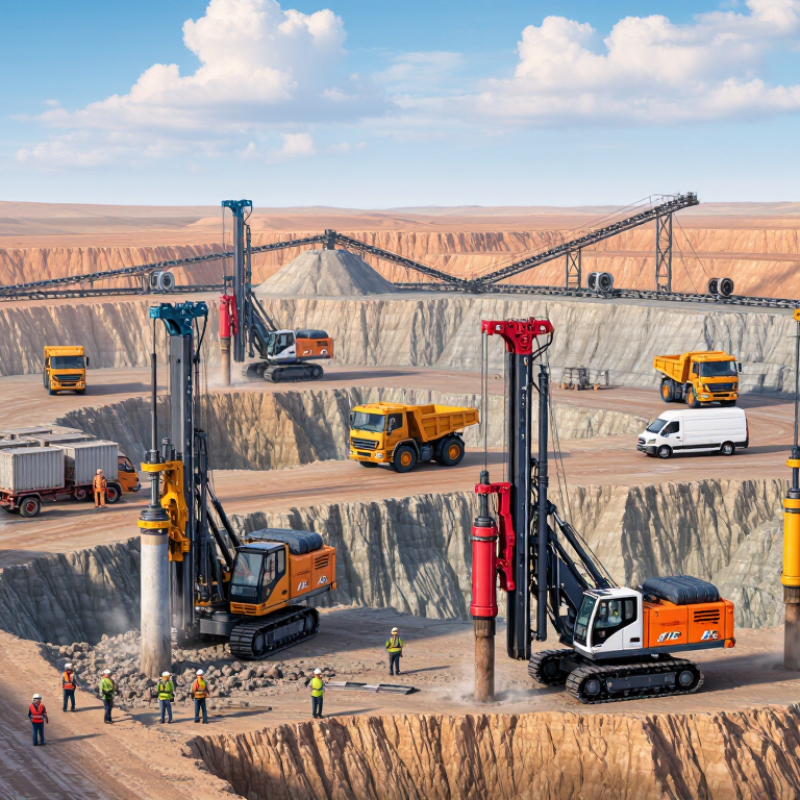
China Top Surface Drilling Rig Manufacturers and Suppliers
Types of Surface Drilling Rigs Made in China
Chinese manufacturers produce several surface drilling rig types for mining, quarrying, construction, and water-well work. Crawler-mounted rigs suit uneven benches and soft ground. Their steel tracks improve stability near quarry edges. Truck-mounted rigs offer faster relocation between sites. They are useful for road projects and scattered drilling points.
Top-hammer rigs handle shallow to medium-depth holes with strong drilling speed. Down-the-hole rigs deliver straighter holes in hard rock and support controlled blasting patterns. Rotary rigs are common for large-diameter holes, foundation work, and mineral exploration. According to Grand View Research’s 2024 mining equipment analysis, the global mining equipment market is expected to expand at about 5.6% annually through 2030. This growth supports demand for safer, more efficient surface drilling systems. However, the correct rig depends on rock strength, hole diameter, dust control, and service access. A high rated output does not guarantee better field results.
Tips: Check compressor capacity, feed force, drilling angle, and spare-part availability together. Ask for test-hole records from similar rock conditions. Inspect the mast, hydraulic lines, and control panel before shipment. Chinese factory specifications can be detailed, but real performance still needs verification. That part is often overlooked. Geological variation can change fuel use, penetration speed, and tool life. Choose measured evidence over attractive numbers.
Leading Chinese surface drilling rig manufacturers are defined by practical engineering, not catalogue size. MarketsandMarkets estimates the global mining equipment market will grow from about USD 135.6 billion in 2023 to USD 171.5 billion by 2028. This expansion rewards suppliers that combine reliable drilling with faster site deployment. Chinese producers increasingly offer crawler-mounted platforms, high-torque rotary heads, and automated rod handling. These features reduce manual exposure around dusty benches and uneven ground.
Energy performance is another important differentiator. The International Energy Agency reports that industry accounts for roughly 37% of global final energy consumption. Efficient hydraulic systems, variable-speed engines, and load-sensing pumps can reduce unnecessary fuel use during idle periods.
Leading manufacturers also design rigs for high-altitude mines, hard rock, and changing temperatures. Remote diagnostics now track engine hours, pressure changes, and drilling depth. Useful data, if technicians actually review it.
Quality control should remain visible. Manufacturers with ISO 9001-based procedures, traceable components, and documented factory testing offer stronger purchasing confidence. Independent field trials matter more than polished brochures. MarketsandMarkets also identifies automation and digital monitoring as major trends in mining equipment development. However, automation is not a complete answer. Sensors can fail in vibration, mud, or extreme cold. Buyers should request maintenance intervals, spare-parts lead times, noise readings, and local service coverage before signing a contract. A low purchase price may hide costly downtime. That lesson is easy to forget.
China’s surface drilling rig manufacturers and suppliers serve mining, quarrying, construction, and geotechnical projects. Their product ranges commonly include crawler rigs, down-the-hole systems, rotary rigs, and hydraulic top-hammer models. According to Grand View Research, the global mining equipment market was valued at approximately USD 143.8 billion in 2023, with continued growth expected through 2030. This wider demand supports China’s role as a competitive production base.
Experienced buyers should compare drilling depth, hole diameter, compressor output, fuel consumption, and ground clearance. For example, a quarry rig drilling 115–165 mm holes needs stable feed pressure and effective dust control. Suppliers should provide test records, component traceability, spare-parts plans, and operator training. ISO 9001 certification can support process reliability, but certification alone does not prove field performance. Site trials still matter.
Chinese suppliers often offer flexible configurations and shorter manufacturing cycles. Some can adjust crawler width, mast length, and control systems for difficult terrain. However, lower prices may conceal weaker sealing, inconsistent weld quality, or limited after-sales support. This risk deserves attention. Reports from MarketsandMarkets indicate that automation and remote monitoring are becoming important trends in drilling equipment. Yet many smaller projects still depend on skilled operators and simple controls. Buyers should inspect completed rigs, review service response times, and request performance data from comparable sites. A polished catalogue is not enough.
China Top Surface Drilling Rig Manufacturers and Suppliers
When evaluating Chinese drilling rig suppliers, begin with the machine’s working conditions, not attractive catalog photos. Match drilling diameter, rock hardness, hole depth, altitude, and dust levels with the proposed model. Ask for complete specifications, including engine output, feed force, rotary torque, air consumption, and fuel use. Small omissions can create expensive surprises.
A factory visit can reveal more than a polished website. Check welding quality, hydraulic hose routing, component storage, and final inspection records. Request load-test videos with visible dates and machine numbers. Confirm whether critical parts have stable replacement channels. Certifications matter, but traceable test documents matter more. One certificate alone proves little.
Speak with recent users operating in similar ground conditions. Ask about downtime, response speed, spare-part delivery, and technician availability. Review the warranty line by line. Clarify what labor, transport, and consumables are excluded. Compare the full operating cost, not only the purchase price. I have seen low bids become costly after repeated hose failures and delayed support. Still, no supplier looks perfect on paper. A factory may have strong engineering but weak English documentation. Another may communicate well but lack field experience. This is where careful questions matter. Record every answer, then test it against evidence. A short trial order may be wiser than a large commitment.
| Evaluation Dimension | Suggested Weight | Key Data to Compare | Practical Benchmark or Requirement | Recommended Verification Evidence | Rating Guide |
|---|---|---|---|---|---|
| Product Application | 10% | Rock hardness, drilling method, hole diameter, hole depth, terrain, and operating temperature | The proposed rig should match the intended application, such as quarrying, mining, construction, water-well, or geotechnical drilling. | Technical data sheet, application list, drilling method description, and reference project details | 1–5 points |
| Drilling Capacity | 12% | Maximum drilling diameter, maximum drilling depth, feed stroke, rotation speed, torque, and impact energy | Published performance figures should include test conditions and should be suitable for the required hole size and depth. | Factory test report, performance curve, operating manual, and witnessed field test | 1–5 points |
| Powertrain and Fuel Efficiency | 10% | Engine output, fuel consumption, compressor capacity, hydraulic system, and power reserve | The power system should provide stable output under continuous drilling loads and comply with the emissions rules of the target market. | Engine specification, fuel-consumption data, emissions documentation, and maintenance schedule | 1–5 points |
| Structural Durability | 10% | Drill boom design, chassis strength, mast construction, weld quality, corrosion protection, and component life | Critical load-bearing parts should have documented material specifications, quality controls, and protection appropriate for outdoor mining or construction environments. | Material certificates, welding procedures, inspection records, and fatigue or load-test results | 1–5 points |
| Quality Management | 10% | Production controls, inspection procedures, traceability, calibration, and nonconformity management | A documented quality-management system, preferably certified to ISO 9001, should cover design, purchasing, assembly, testing, and after-sales service. | Valid certificate, audit report, inspection plan, serial-number traceability, and final inspection records | 1–5 points |
| Safety and Compliance | 12% | Emergency stop systems, guarding, operator visibility, noise, dust control, electrical safety, and market-specific conformity | The rig should include documented risk controls and meet the legal and safety requirements of the country where it will operate. CE marking may be relevant for the European Economic Area but does not replace all local obligations. | Risk assessment, declaration of conformity where applicable, safety manual, test reports, and machine drawings | 1–5 points |
| Component Availability | 8% | Hydraulic pumps, valves, motors, compressors, engines, drill heads, filters, and wear parts | Common replacement parts should have clear part numbers, defined service intervals, and a realistic supply plan for the destination market. | Parts catalogue, recommended spare-parts list, supplier details for major components, and stock policy | 1–5 points |
| After-Sales Service | 10% | Installation, commissioning, operator training, troubleshooting, field service, and response time | The supplier should provide documented commissioning support, technical manuals, remote assistance, and an escalation process for breakdowns. | Service network map, training plan, support contact process, service-level terms, and customer references | 1–5 points |
| Warranty Coverage | 6% | Warranty period, covered assemblies, exclusions, labor coverage, and claim procedure | A written warranty should clearly define the coverage period, normally beginning at delivery or commissioning, together with exclusions and claim requirements. | Signed warranty policy, warranty registration procedure, spare-parts terms, and sample claim workflow | 1–5 points |
| Delivery and Customization | 6% | Lead time, production capacity, packaging, shipping dimensions, optional equipment, and documentation | The supplier should confirm a realistic production schedule, export packaging method, shipping weight, loading plan, and configuration change procedure. | Production schedule, pro forma invoice, packing list template, inspection milestone plan, and shipping documents | 1–5 points |
| Total Cost of Ownership | 6% | Purchase price, transport, import charges, fuel, consumables, maintenance, downtime, and resale value | The lowest purchase price should not be used as the sole criterion; compare expected operating cost and service availability over the planned service life. | Five-year cost model, fuel and maintenance estimates, consumables schedule, and downtime assumptions | 1–5 points |
Scoring method: Rate each dimension from 1 to 5, multiply the rating by the suggested weight, and compare the resulting weighted scores. All technical, compliance, delivery, and warranty claims should be confirmed in writing before purchase.
China Top Surface Drilling Rig Manufacturers and Suppliers
Applications and Industries Served by Chinese Drilling Rigs
Chinese surface drilling rigs support demanding work across mining, quarrying, construction, water-well development, and geothermal projects. In open-pit mines, operators use them to drill blast holes through hard rock benches. Quarry teams may need accurate holes in granite or limestone, often under dusty and uneven conditions. Construction contractors use compact rigs for foundation piles, road cuts, slope stabilization, and utility projects. Water-well rigs require stable rotation and dependable flushing when drilling through changing soil layers.
Machine selection should match the ground, hole diameter, depth, and working space. A tracked rig can move across rough benches more safely than a wheeled unit. Air compressors must provide enough pressure for effective cuttings removal. In geothermal work, crews may prioritize drilling depth, cooling performance, and long operating cycles. Chinese manufacturers and suppliers commonly provide different configurations, but specifications still need independent verification. A brochure cannot replace a site trial.
Tips: Check service records, spare-parts access, operator training, and local safety compliance before purchasing. Ask for test data under similar rock conditions. Inspect the mast, feed system, hydraulic lines, and dust-control equipment. Small details matter. Even careful planning can miss unexpected fractures or unstable ground. Experienced operators should review the final choice, because the cheapest rig may create higher downtime and maintenance costs.
Accreditations
ISO 9001 Quality Management
HSE Management Compliant
Products and services comply with relevant Australian (AS) and international (ISO, etc.) Standards.
"*" indicates required fields